
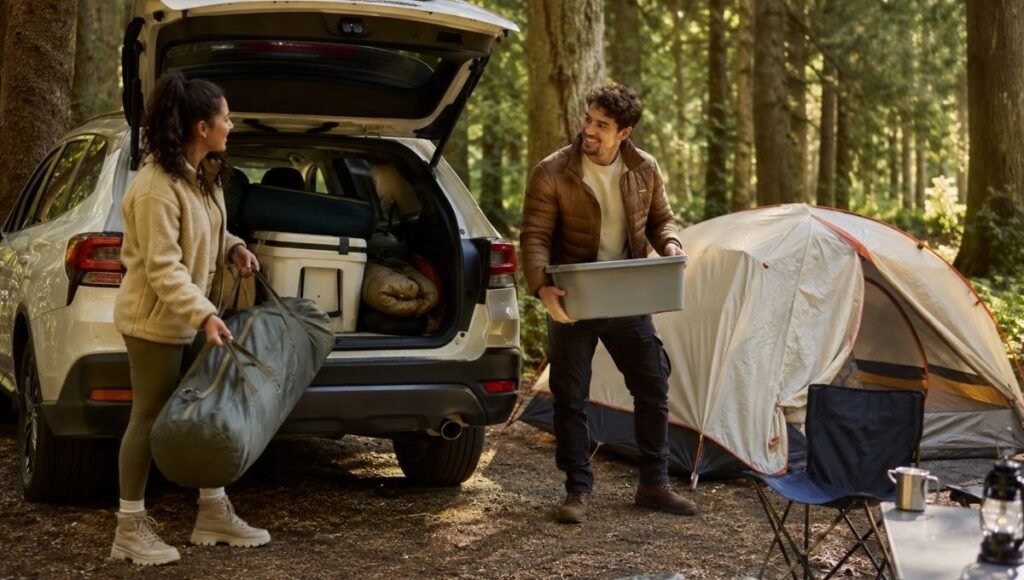
Everything you need to know about your first car camping trip — what it actually means, what to bring, how much it costs, and why it might be the best outdoor decision you ever make.
Key Takeaways
- Car camping refers to camping at a drive-up campsite where your vehicle parks at or near your spot — meaning you can bring everything that fits in your car, including a full cooler, chairs, and a proper tent
- A solid first car camping trip can cost $35–60 per night for a campsite, significantly less than most hotels or Airbnbs in the same area
- The single most impactful car camping purchase for beginners: a quality sleeping pad — it affects sleep quality more than almost any other item
- Condensation is the most common surprise for first-time car campers who sleep in their vehicles — crack your windows slightly or you’ll wake up damp from your own breath
- Book your campsite well in advance for weekends — popular sites near national parks and state parks often fill up weeks or months ahead
Here’s a scenario that comes up a lot: someone decides they want to try camping, then spends an hour on the internet reading about gear, gets overwhelmed, and quietly decides “maybe next summer.” The tent selection alone could fill an entire weekend. The sleeping bag temperature rating system is its own research project. And somewhere in the middle of reading about bear canisters, the original appeal of “just getting outside” gets buried under an avalanche of equipment.
Car camping is the antidote to all of that.
It’s not a compromise version of real camping. It’s camping that actually gets you outside on a timeline that works for a normal person with a normal schedule — you drive to a campsite, you have everything you brought in the car, you sleep outside or in your vehicle, and you go home when you want to. There’s a reason so many experienced campers started here, and a reason most of them still go back to it regularly. It’s genuinely good, and it’s dramatically more accessible than most beginner camping content makes it seem.
This guide explains exactly what car camping is, how it compares to other camping styles, what you actually need to get started, and how to plan your first trip without overthinking it.
What Is Car Camping? (Clearing Up the Confusion)
This is the question that trips up almost every beginner, because “car camping” actually gets used to mean two slightly different things — and knowing the difference matters before you plan anything.
Definition 1: Camping at a drive-up campsite This is the most common use of the term. You drive your car directly to a campsite (usually at a state park, national forest, or private campground), park at your spot, and set up camp next to your car. Your vehicle stays within feet of where you sleep. You can bring a tent, a full cooler, camp chairs, a two-burner stove, firewood, and basically anything that fits in your car — because you never have to carry any of it more than a few steps.
Definition 2: Sleeping inside your car Some people use “car camping” specifically to mean sleeping in the back of their vehicle rather than in a tent. This is popular with SUV and hatchback owners who fold down rear seats and create a flat sleeping platform.
For this guide, we’re focusing on Definition 1 — camping at a drive-up campsite — because it’s the most beginner-friendly format and the best starting point for anyone new to sleeping outside. Definition 2 (sleeping in your car) has its own specific setup considerations, and we’ll touch on it briefly, but it’s a subset of the broader car camping experience rather than the whole picture.
The important thing to know: either way, your car is your base camp. You never leave it far behind.
Why Car Camping Is the Best Starting Point for Beginners
There are several styles of camping — tent camping, backpacking, RV camping, van life, glamping — and they exist on a spectrum from most accessible to most demanding. Car camping at a developed campground sits squarely at the accessible end, and that’s not a negative thing.
Weight doesn’t matter. Everything goes in the car. You can bring a real cooler with actual food, a camp chair you’ll actually be comfortable sitting in, a lantern, a folding table, and a tent big enough to move around in. When you’re not carrying anything on your back, the calculus around gear changes completely.
You can bail. If it rains unexpectedly, if you didn’t sleep well the first night, if the campground is louder than expected — your car is right there. You can leave. This makes the risk level of a first camping trip much lower than it otherwise would be, and it genuinely matters for building outdoor confidence.
The cost difference is real. A campsite at a developed campground typically runs $25–50 per night depending on location and amenities. A hotel or Airbnb in the same area often runs $150–300+ for the same dates. That cost difference adds up fast over a long weekend, and it’s one of the most underrated arguments for car camping as a travel format — not just as a wilderness experience.
It’s a genuine introduction to camping skills. You learn how to read a campsite, set up a tent, manage food storage, cook outdoors, deal with bugs and weather, and sleep somewhere that isn’t your bed — all with the security of your car nearby and a campground with bathrooms within walking distance. These are the same skills you’ll use for more advanced camping later.
Car Camping vs. Tent Camping: What’s the Actual Difference?
The terminology here is genuinely confusing because they overlap. Here’s the honest breakdown:
“Tent camping” typically refers to camping at a drive-up campsite where you sleep in a tent. You set up a tent, sleep in it, and your car stays nearby.
“Car camping” in common use refers to the same type of camping — drive to site, camp next to car — but the term emphasizes that the car is central to the experience (versus backpacking, where you hike everything in on your back).
In practice: most people use these terms interchangeably for drive-up campsite camping. The key distinction is between car camping / tent camping (drive to campsite) versus backpacking (hike everything in) versus RV camping (sleep in the vehicle with full amenities).
For your first trip: car camping and tent camping mean the same thing. You drive to the campsite, you set up a tent, you sleep outside. The car is right there as your support vehicle.
What to Bring Car Camping: The Essentials List
One of the great advantages of car camping is that you’re not weight-constrained. But that same advantage is also how beginners end up with a chaotic, overpacked car and no idea where anything is when they need it. The goal is to bring what you actually need, organized so you can find it.
Sleep System
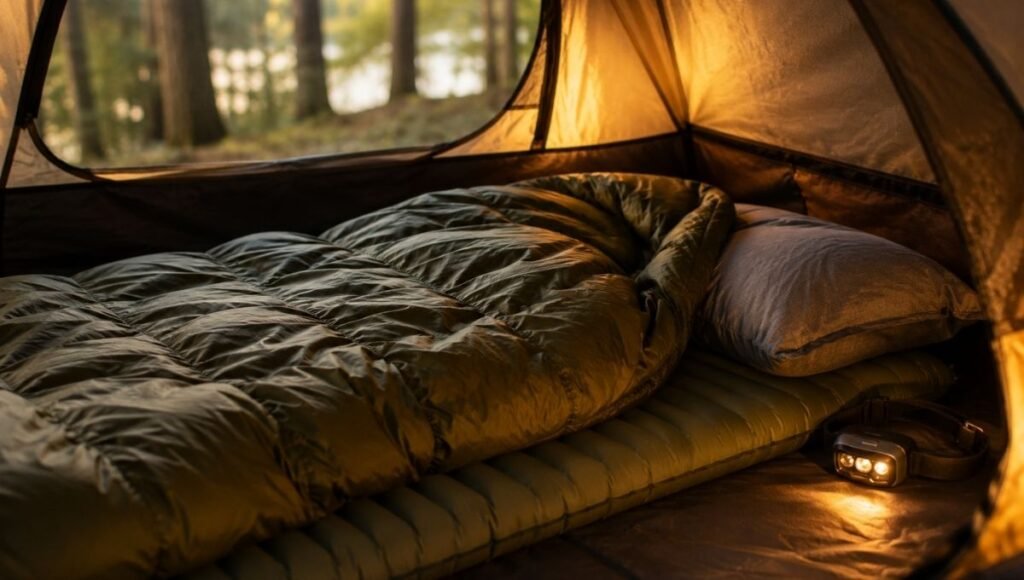
Tent: Size up from what you think you need. A tent marketed as “2-person” fits two people with nothing else in it — no bags, no space to sit up comfortably. For two adults, a 3-person tent gives you actual living space. For car camping, weight is irrelevant, so there’s no reason to choose the smallest tent.
Sleeping bag: Rated for the expected nighttime low temperature, with a 10–15°F buffer below what you expect. Nights at campgrounds are almost always colder than first-timers anticipate, especially after the sun goes down completely.
Sleeping pad: This is the most consistently underestimated item for first-time campers, and the one that most directly affects sleep quality. Ground cold conducts heat away from your body far more aggressively than cold air does. A sleeping bag rated to 30°F on bare ground will still produce a cold, uncomfortable night. Get a sleeping pad with an R-value of at least 2.0 for three-season camping.
Pillow: A packable camp pillow or just your pillow from home (you’re driving, after all — it fits).
Kitchen Setup
Camp stove: The two-burner Coleman propane stove (~$50) is recommended across virtually every camping community for car camping. It’s reliable, easy to use, and cooks at nearly home-stove capacity. Bring extra propane canisters. A single-burner backpacking stove works for solo trips but becomes limiting for cooking actual meals.
Cookware: A pot and a pan cover almost every camp cooking scenario. Bring utensils, a cutting board, plates and bowls, mugs, and a can opener (the most commonly forgotten kitchen item).
Cooler: For car camping, a quality hard-sided cooler with enough ice for your trip duration. Block ice lasts significantly longer than cubed. Keep drinks and food in separate coolers if possible — drink coolers get opened constantly and drain ice faster.
Cleaning supplies: Biodegradable dish soap, a small sponge, and a wash basin or dishpan for cleaning up. Trash bags — more than you think you’ll need.
Comfort and Camp Life
Camp chairs: One per person. Sitting on the ground all evening gets old quickly. This is one of the items where “because it’s comfortable” is a completely valid reason to bring it.
Headlamp: Every person in your group needs their own headlamp. Not a flashlight — a headlamp, so both hands are free. Essential at night for everything from cooking to bathroom trips.
Camp lantern: For ambient lighting at the campsite after dark. LED lanterns are the most practical — no fuel management, long battery life.
Folding table: Many campgrounds have picnic tables, but not all. A lightweight folding table is one of the quality-of-life upgrades that makes camp cooking dramatically easier.
Clothing
The consistent mistake across camping communities: not enough warm layers.
Daytime temperatures at campgrounds can be comfortable or even warm. Nighttime temperatures — especially once the campfire dies or you’re back in the tent — can be 20–30°F colder than the afternoon felt. Pack layers you won’t need and you carry a little extra weight in the car. Forget them and you have an uncomfortable night.
The minimum: a warm mid-layer (fleece or down jacket), a waterproof outer layer, and one more warm layer than you think you’ll need.
Safety Essentials
- First aid kit (see our complete hiking first aid kit guide for what to include)
- Headlamp with fresh batteries (covered above)
- Phone charger and portable power bank
- Emergency contact information left with someone at home (which campground, which site, when you expect to return)
How to Find and Book a Car Camping Site
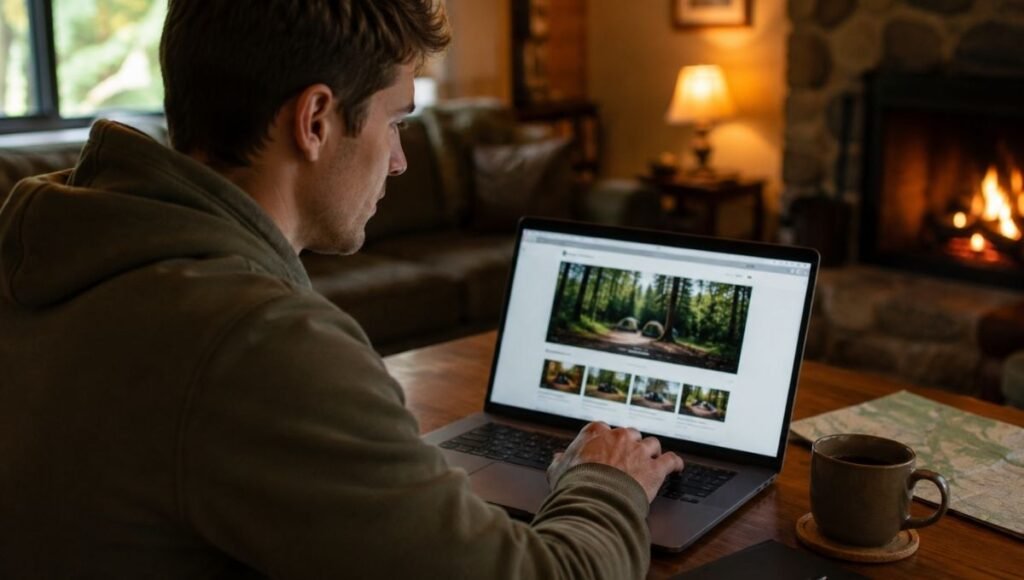
This is where many first-timers get stuck — not because it’s difficult, but because there are several platforms and the process isn’t obvious until you’ve done it once.
Recreation.gov covers federal campgrounds — national parks, national forests, BLM land. Most major campgrounds in popular outdoor destinations are booked here. Reservations open on a rolling window (typically 6 months in advance) and popular sites fill up minutes after they become available.
Reserve America covers most state park campgrounds. Similar booking process, slightly different inventory.
Hipcamp is privately-owned camping sites — farm fields, private forest land, vineyard camping. Often more affordable and more flexible than public campgrounds. Easier to find availability on shorter notice.
The Dyrt is a community-based campground database with user reviews, photos, and a mix of free and paid sites. Excellent for finding sites beyond the most well-known campgrounds.
What to Look for in Your First Campsite
Amenities that make a first trip easier: Flush toilets (rather than vault toilets), potable water at or near the site, and a campfire ring. Not every campground has all three, and knowing in advance avoids unpleasant surprises.
Site selection tips: Look at the campground map before booking, not just the campground in general. Sites near bathroom facilities are more convenient but also noisier. Sites at the edges of loops often have more privacy. Sites near water can be beautiful or mosquito-heavy depending on the season.
Timing matters for availability: Summer weekends at any campground near a population center fill up fast — sometimes months in advance. Weekday camping is almost always easier to book and significantly quieter on arrival. Shoulder season (late spring, early fall) is often the best combination of good weather and manageable crowds.
Editor’s note: For your first trip, prioritize a campground with flush toilets and running water over a more scenic but more primitive option. The creature comfort removes one layer of uncertainty and makes the whole experience more enjoyable when you’re not yet sure what you’re doing.
Setting Up Your First Car Campsite: Arrival to First Night
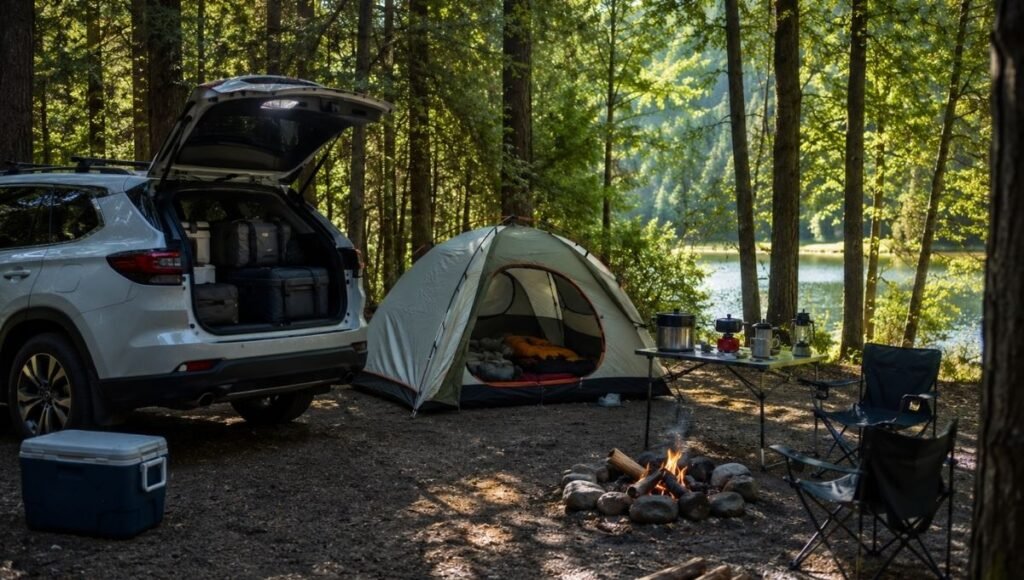
Arrive before dark. This is the most consistently useful piece of advice in camping communities. Setting up camp — finding your site, unloading, setting up the tent, organizing your kitchen area — takes longer than you expect the first time. An hour or two of daylight buffer makes everything easier.
Set up the tent first, before anything else. You need to know where your bedroom is before it gets dark. Once the tent is up and sleeping pads are inside, everything else is secondary.
Organize your kitchen area separately from your sleeping area. Food smells attract wildlife — from raccoons at developed campgrounds to more serious animals in bear country. Keep your kitchen area downwind from your tent and never store food inside your tent. At night, food goes in your car or in the campground’s provided bear boxes (check whether these are available before you rely on them).
Find the bathroom before you need it at 2am. Walk to the facilities while it’s still light. Know the path. Have your headlamp ready.
Car Camping Setup: Order of Operations
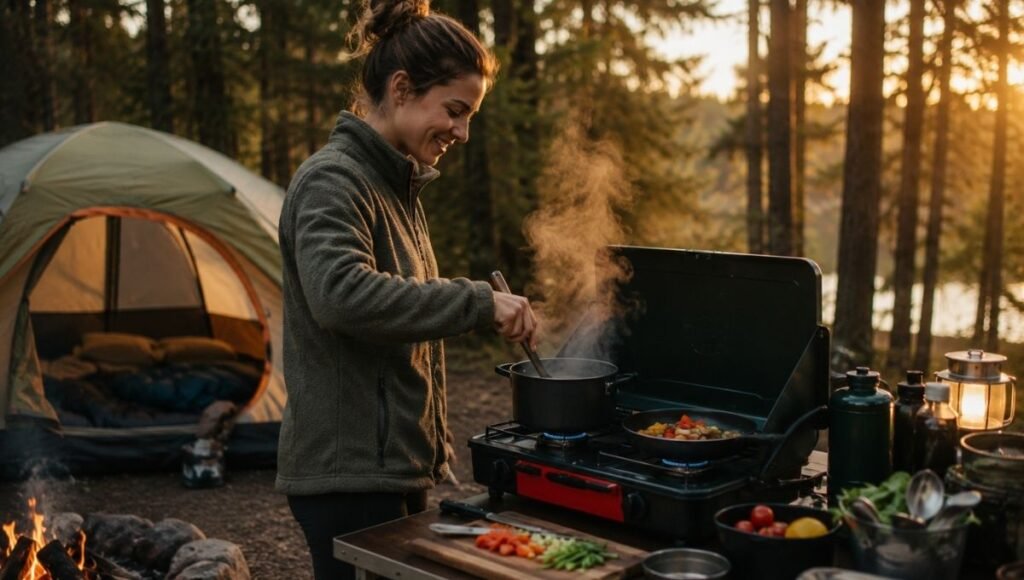
- Find your specific campsite (they’re numbered — match yours to the sign)
- Unload the car at the site
- Set up tent and sleeping system
- Set up kitchen area (stove, cooler, cooking supplies)
- Set up seating area (chairs, table)
- Walk to bathrooms to find them while it’s light
- Start campfire if permitted and desired
Car Camping Food: What to Make and How to Manage It
Car camping food can be as simple or as elaborate as you want, and one of the genuine pleasures of this style of camping is that you have a real cooler and a real stove.
Keep it simple for your first trip. You’re managing a lot of new variables — the campsite, the tent, the night sounds, the morning routine. Easy meals let you focus on the experience rather than the logistics.
Simple first-trip meal plan:
- Breakfast: Eggs scrambled in a pan + instant coffee or tea, OR overnight oats prepared the night before
- Lunch: Sandwiches, crackers, cheese, fruit
- Dinner: Hot dogs or sausages cooked over the fire + chips, OR pasta with jarred sauce on the stove
Food storage rules:
- Never leave food out overnight, even in campgrounds without bears
- Store food in your car when not eating
- In designated bear country: always use bear boxes or hang food — check campground regulations before arrival
One piece of advice about cooking: Prep as much as possible at home. Chopped vegetables, marinated proteins, pre-measured spices — anything you can do in your kitchen before you leave reduces the work at camp and significantly reduces what you need to clean up.
For more camp cooking ideas, see our easy camping meals guide.
Sleeping in Your Car vs. In a Tent: Which Is Better for Beginners?
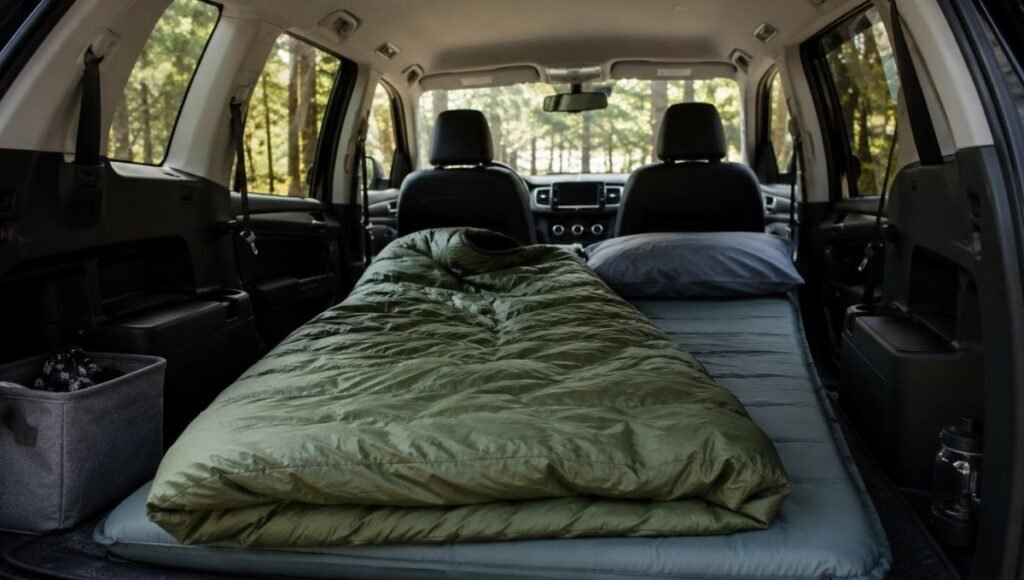
Both are valid car camping options, and many beginners start with the car setup before transitioning to a tent.
Sleeping in your car (for SUVs, hatchbacks, trucks):
- Fold down rear seats to create a flat surface
- Sleeping pad or vehicle-specific mattress on top
- Window covers for privacy and temperature management
- Critical tip: crack your windows. Your breath produces significant moisture overnight. Without ventilation, you’ll wake up in a condensation-covered car that feels distinctly unpleasant. Crack two opposing windows slightly — the cross-breeze prevents condensation without letting in cold air.
- Check for mosquitoes near your cracked windows; small mesh covers prevent insects while allowing airflow
Sleeping in a tent:
- More space for movement and gear organization
- Separate sleeping area from “living” area
- Standard camping experience for building outdoor skills
- Usually more comfortable for groups of two or more
The honest take: Most beginners who start by sleeping in their car eventually move to a tent because the extra space and the psychological separation of “this is where I sleep” makes the experience feel more complete. But sleeping in your car is a completely legitimate approach, especially for solo travelers and first-timers who feel more comfortable with a harder shell around them.
Car Camping Mistakes Beginners Always Make
Arriving late. Setting up camp in the dark, especially for the first time, is stressful and slower than expected. Leave earlier than you think you need to.
Overpacking food. Car campers consistently bring more food than they eat. The combination of outdoor air, cooking over fire, and actually relaxing has a paradoxical effect on appetite — you eat more than you do at a desk but still don’t finish what you packed for a “just in case” scenario.
Underpacking warm layers. Every car camping community says this, every first-timer ignores it, every first-timer wishes they hadn’t. Nights are cold. Bring one more warm layer than you think you need.
Storing food in the tent. It attracts animals. In bear country, it’s also genuinely dangerous. Everything edible goes in the car or bear box at night.
Not testing gear before the trip. Set up your tent at home at least once. Make sure you have all the poles and stakes. Figure out the rainfly before you’re in the dark at a campsite trying to read instructions on your phone.
Forgetting the can opener. If you’re bringing any canned food. Check. Twice.
If You Only Have 15 Minutes to Plan
Committed to going this weekend with minimal research time? Here’s the minimum viable plan:
- Book a campsite on Recreation.gov, Reserve America, or Hipcamp — look for one with flush toilets and running water
- Pack: tent (practiced setup), sleeping bag, sleeping pad, headlamp, layers, food for all meals, water, first aid basics
- Bring your camp stove and fuel if you have them; if not, plan for no-cook meals for one night
- Tell someone where you’re going and when you’ll be back
- Arrive at least 2 hours before sunset
That’s enough to have a real, successful first car camping trip.
FAQ: Real Questions About Car Camping
Q: What is car camping exactly? Car camping means camping at a drive-up site where your vehicle parks at or near your campsite. You can bring anything that fits in your car — a full cooler, a proper tent, chairs, and a stove — because you never have to carry gear any real distance. It’s the most accessible form of camping and the best starting point for beginners.
Q: How much does car camping cost? A campsite at a developed campground typically runs $25–50 per night. Budget campgrounds and dispersed camping on BLM land can be free or under $15. Compare this to hotels or Airbnbs in the same area — usually $150–300+ per night — and car camping quickly becomes one of the most affordable ways to travel and get outside.
Q: What do I need for my first car camping trip? The essentials: tent, sleeping bag, sleeping pad, headlamp, camp stove and fuel, cooler with food, water, appropriate clothing layers, and a first aid kit. For the complete packing list, see our camping packing list guide.
Q: Can I sleep in my car instead of a tent when car camping? Yes — for SUVs, hatchbacks, and trucks with fold-flat seats, sleeping in your vehicle is a completely valid approach. The main practical considerations are a flat sleeping surface, some form of window covering for privacy, and ventilation (crack your windows to prevent condensation from your breath).
Q: How do I find campsites for car camping? Recreation.gov covers federal campgrounds (national parks, national forests). Reserve America covers state parks. Hipcamp and The Dyrt cover a broader range including private sites. For your first trip, search for developed campgrounds with flush toilets and running water to simplify the experience.
The Best First Step You Can Take
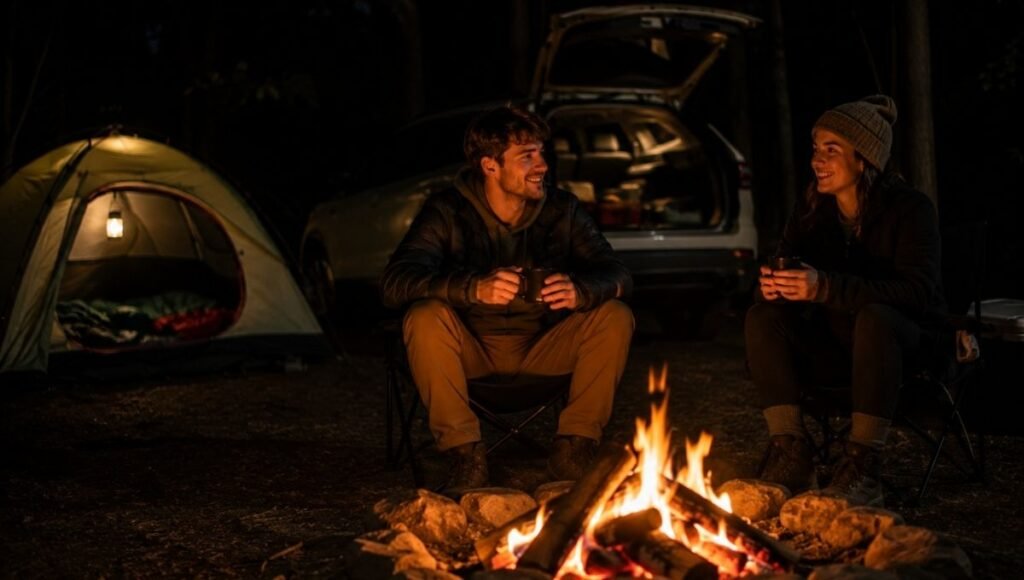
Car camping consistently converts people who were nervous about camping into people who can’t stop planning their next trip. It’s accessible, affordable, and genuinely good — not a compromise, not a gateway drug, but an outdoor experience that stands on its own.
Find a campsite, pack what you need, arrive with daylight to spare. The rest of it — the sounds at night, the coffee in the morning, the fire when it finally catches — takes care of itself.
Keep building your camping knowledge:
- The Complete Camping Packing List for Beginners
- How to Set Up a Tent for the First Time
- Easy Camping Meals for Beginners
- Camping for Beginners: The Complete Guide
- Outdoor Safety for Beginners
References
- National Park Service. Camping in National Parks — Campground Guidelines and Reservations. nps.gov
- Recreation.gov. How to Find and Book a Campsite. recreation.gov
- Leave No Trace Center for Outdoor Ethics. Leave No Trace Principles — Camping and Food Storage. lnt.org
- USDA Forest Service. Dispersed Camping and Developed Campground Guidelines. fs.usda.gov
- American Camp Association. Camping Industry Overview and Safety Guidelines. acacamps.org