
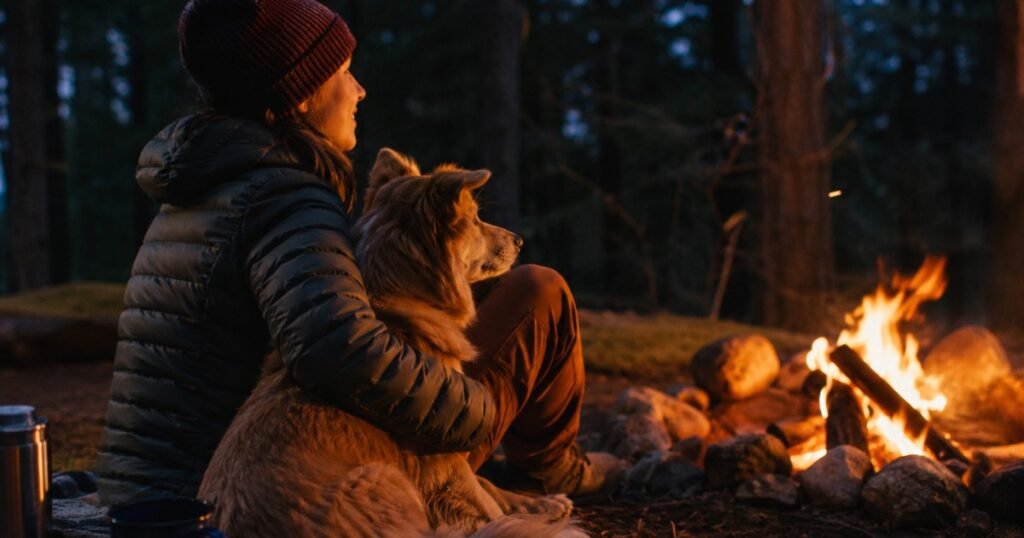
Real advice for first-time dog campers—from backyard practice runs to the nighttime situations most guides never mention.
Picture this: you’ve just pulled into your campsite after a three-hour drive. While you’re trying to figure out the tent poles, your dog is pulling toward every new smell, the leash is wrapped around your ankle, and your gear is scattered across the ground. Before the tent is even standing, you’re already wondering if bringing your dog was a good idea.
If that sounds familiar, you’re not alone. The biggest challenge of camping with a dog usually isn’t the trail or the gear—it’s helping your dog adjust to an unfamiliar environment while you’re busy setting up camp and following campground rules.
The good news is that most of these problems are preventable. With a little preparation before you leave home, you can avoid the common mistakes that turn a relaxing camping trip into a stressful weekend.
In this guide, you’ll learn how to tell if your dog is ready for camping, what gear is actually worth packing, how to keep your dog calm during camp setup, and how to handle nighttime safety, wildlife, weather, and other situations that catch many first-time campers by surprise.
Quick Answers
| Question | Quick Answer |
|---|---|
| Can most dogs go camping? | Yes—if they’re healthy, comfortable on a leash, and gradually introduced to outdoor environments. |
| Should my dog sleep inside the tent? | In most cases, yes. Sleeping inside is safer and helps reduce stress and wildlife risks. |
| What’s the most important thing to pack? | Clean water, a 6-foot leash, ID tags, and a sleeping mat. |
| How can I stop my dog from barking? | Exercise them before camp, reduce visual triggers, and keep them mentally occupied. |
| What’s the biggest beginner mistake? | Assuming camping is just hiking with a tent instead of preparing your dog for a completely new environment. |
Is Your Dog Actually Ready for Camping?
Before you book a site, there’s an honest question worth answering: is your specific dog a good candidate for camping right now? The answer isn’t always yes — and knowing this early saves a genuinely miserable trip.
Signs Your Dog Is Ready
A camping-ready dog doesn’t need to be perfectly trained. But a few things make the experience dramatically more manageable:
Responds to their name reliably. Not perfect recall in every situation, but when you call your dog’s name with intention, they look at you. This is the baseline behavior that lets you redirect attention before small problems become big ones.
Tolerates being on leash for extended periods. Campgrounds require leashed dogs in most areas. If your dog pulls constantly and is exhausted by a 30-minute leashed walk, a full camping day will be challenging for both of you.
Has spent time in unfamiliar outdoor environments without unmanageable anxiety. A trip to a new park, a hike on an unfamiliar trail — if your dog can handle novelty without shutting down or going into sustained high-alert barking, they’ll likely do reasonably well at camp.
Is past the peak-destruction puppy phase. This isn’t an absolute rule, but a 10-month-old puppy who still chews everything and has no impulse control is going to test every piece of camping gear you own. There’s a reason experienced dog campers often suggest waiting until at least 12–18 months for the first camping trip.
Dogs That Should Start with Short Outdoor Trips First
Some dogs need a more gradual introduction to outdoor environments before a full overnight camping trip makes sense:
Highly reactive dogs — dogs that bark intensely at other dogs, people, or unfamiliar sounds — struggle at campgrounds where stimulation is constant and unpredictable. This doesn’t mean they can’t eventually be great camping dogs. It means starting with quiet, off-peak visits to parks and building from there.
Dogs with significant separation anxiety — camping involves a lot of time where you’re busy with camp tasks and your dog needs to be settled without your full attention. A dog that can’t be calm when you’re 10 feet away putting up a tent is going to find the campsite overwhelming.
Very young or very old dogs — puppies tire easily and can’t regulate their temperature as efficiently. Senior dogs may struggle with sleeping on the ground and extended activity. Both can still camp — but trip length, distance, and setup need to account for their limits.
Simple Backyard Practice Before Your First Camping Weekend
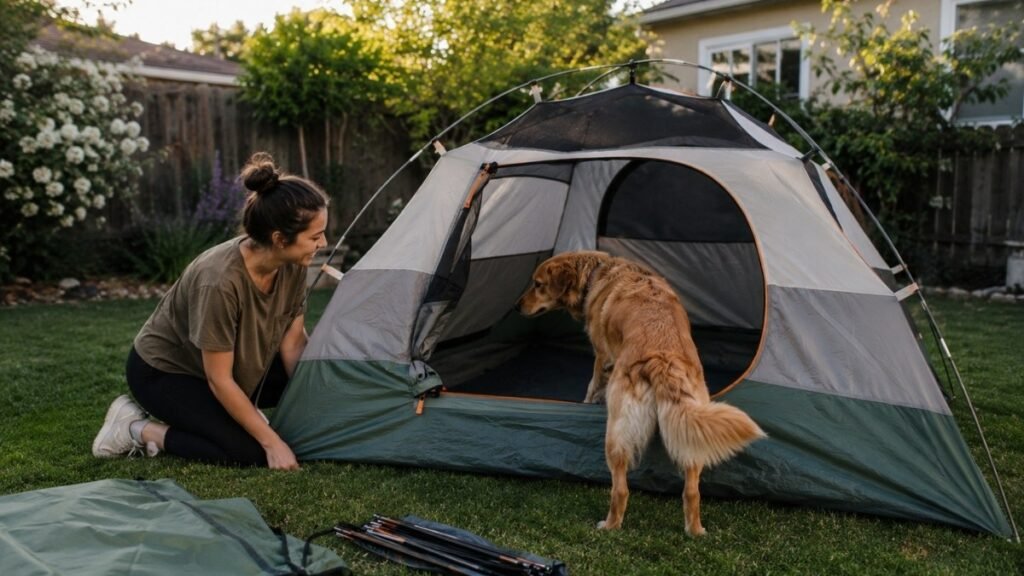
This is the single most impactful thing you can do before your first dog camping trip, and the thing most first-timers skip entirely.
Set up your tent in the backyard. Let your dog investigate it while it’s being assembled — all the unfolding, the poles clicking together, the stakes going in. Let them sniff around the inside. Feed them treats inside the tent. Do this for 20–30 minutes over two or three separate days.
What you’re doing is called systematic desensitization — gradually exposing your dog to the sights, sounds, and smells of camping in a controlled environment where their stress level stays low. A dog that has already decided the tent is “normal” will settle into it at the campsite far more quickly than a dog encountering it for the first time.
The same principle applies to sleeping arrangements. If you plan to have your dog sleep inside the tent, start having them sleep in the tent (in the backyard) before the trip. The first time a dog sleeps in an enclosed canvas space with unfamiliar outdoor sounds shouldn’t be on night one of a real camping trip.
Before You Leave: The 10-Minute Prep That Prevents Most Camping Problems
Most dog camping problems are administrative failures — missing documentation, unknown campground rules, forgotten medications. None of this is complicated to prepare for. It just requires checking before you leave, not after you arrive.
Vaccinations and Parasite Prevention
Confirm your dog’s vaccinations are current before any trip into nature. At minimum: rabies (required at virtually all campgrounds), distemper, and parvovirus. If your dog will be around other dogs — which is virtually guaranteed at any developed campground — bordetella (kennel cough) is also recommended.
Flea and tick prevention is not optional for camping. Tick populations vary by region and season, but any time you’re in a wooded or grassy environment, ticks are a realistic possibility. Make sure your dog is on a current flea and tick preventative before you go, not after you find one attached.
Rabies Records Some Campgrounds Actually Check
This surprises a lot of first-time dog campers: many developed campgrounds — particularly state parks — require proof of current rabies vaccination at check-in. Not just “we recommend it.” They ask. If you can’t produce documentation, you may not be allowed to bring your dog onto the property.
Keep a physical copy of your dog’s most recent vaccination record in your camping bag. Your vet can print or email one. Storing it in your phone is useful backup, but physical paper is more reliable when cell service is uncertain.
Microchip and ID Tags
Check that your dog’s ID tags are current — correct phone number, readable text — before any camping trip. Check that their microchip registration is current with your current contact information. This takes five minutes on the microchip registry’s website.
At a campground, dogs have more opportunities to become separated from their owners than in everyday life: unfamiliar terrain, distraction from wildlife, accidental leash release, or a tent zipper left slightly open. A found dog with current ID tags gets home. One without takes significantly longer.
Researching Pet-Friendly Campground Rules
Not all campgrounds are equally dog-friendly, and the rules vary enough that it’s worth checking the specific site before booking.
Common restrictions that catch people off guard:
- Dogs allowed in campsites but not on trails (more common than you’d expect)
- Dogs allowed only in certain loops or sections of a campground
- Breed restrictions at some private campgrounds
- Quiet hours that apply to dog barking (with actual enforcement)
- Leash length requirements (usually 6 feet maximum)
Check the campground’s specific pet policy page — not just “dogs allowed” — before booking. A quick phone call to the campground host resolves any ambiguity.
The Beginner-Friendly Camping Checklist for Dogs
Organized by how you’ll actually use these items at camp, not by product category.
Food & Water Essentials
- [ ] Dog food for the entire trip plus one extra day’s worth
- [ ] Collapsible food and water bowls (pack flat, weigh almost nothing)
- [ ] Extra water — dogs drink more during activity and in heat
- [ ] Portable water bottle or hydration pack with a dog-friendly spout
- [ ] Dog treats (high-value ones are useful for redirection and reward at camp)
- [ ] Dog food storage container with a tight lid (keeps smells contained and wildlife away)
Sleeping Gear
- [ ] Dog sleeping pad or small mat (keeps them off cold ground; protects tent floor)
- [ ] Dog blanket or sleeping bag (for cold nights — dogs lose body heat to the ground just like humans)
- [ ] A familiar item from home — their regular bed, a worn t-shirt — provides comfort in an unfamiliar environment
Walking & Tie-Out Setup
- [ ] 6-foot standard leash (not retractable — more on this below)
- [ ] Backup leash
- [ ] Harness (backup collar and harness in case one breaks or gets lost)
- [ ] Cable tie-out stake (the corkscrew type that goes into the ground) — allows your dog to move within a fixed radius without you holding the leash during camp tasks
- [ ] Runner line (a longer cable strung between two trees with a shorter trolley leash) — gives more range of motion than a stake for longer stays; particularly good for dogs that get restless
- [ ] Car tire anchor (park over a carabiner clip attached to a long leash) — an effective no-stake tie-out solution when the ground is too hard or rocky for a stake
Cleaning Supplies
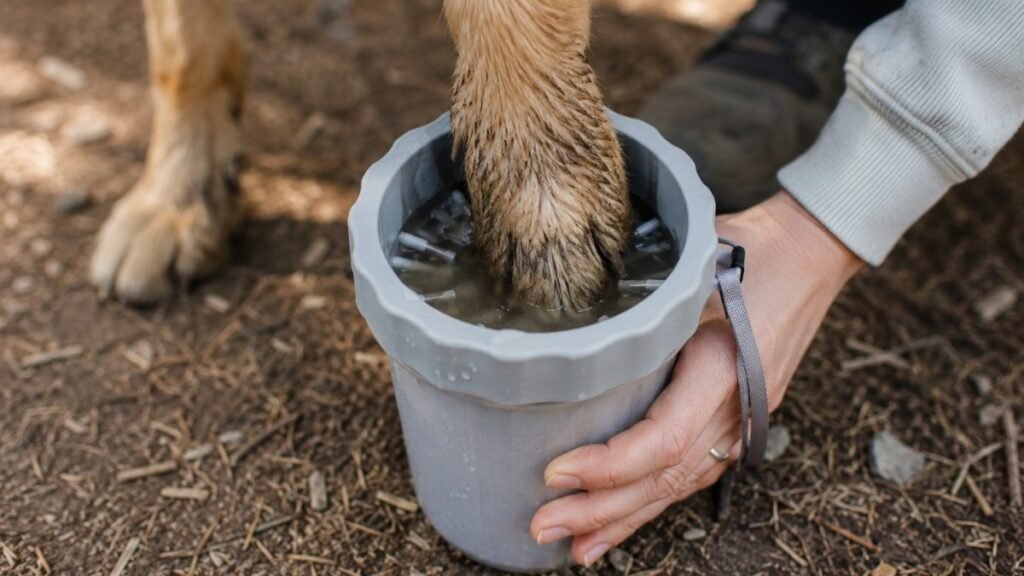
- [ ] Mudbuster (paw cleaning cup) — fill with water, insert paw, twist — 30 seconds per paw instead of wrestling with a wet towel; the difference between clean sleeping bags and muddy sleeping bags
- [ ] Baby wipes or pet-specific wipes (for quick cleanup of paws, face, and any mystery substances encountered on trail)
- [ ] Poop bags (more than you think you need — double what you’d normally bring)
- [ ] Quick-dry towel (for post-rain and post-water situations)
- [ ] Small spray bottle with diluted dog-safe soap for messier cleanups
Safety Essentials
- [ ] LED collar or clip-on light (non-negotiable for nighttime — covered in detail later)
- [ ] Basic dog first aid kit: gauze, bandage wrap, saline for eye/wound rinse, tweezers for ticks, styptic powder for nail injuries
- [ ] Tick remover tool (not just tweezers — a proper tick remover reduces the risk of leaving the head embedded)
- [ ] Any prescription medications your dog takes
- [ ] Your vet’s phone number and the nearest emergency vet’s address (look this up before you go, not after you need it)
Setting Up Camp Without Your Dog Causing Chaos
The 20–30 minutes between arriving at a campsite and having a functional camp is peak chaos time for dogs. New smells, new sounds, unfamiliar territory, and an owner who is distracted and not focused on them — it’s the combination most likely to produce barking, pulling, or creative trouble-making.
How to Keep Your Dog Occupied While Pitching a Tent
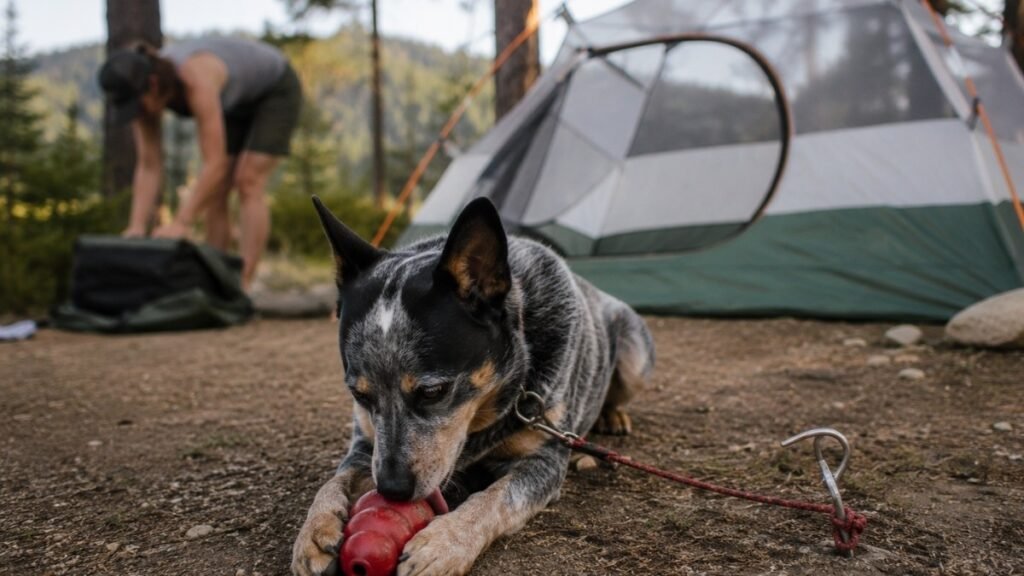
The most consistent recommendation from dog camping communities, backed by the experience of basically every dog owner who camps regularly: bring a frozen KONG or high-value chew for setup time.
A KONG stuffed with peanut butter (or your dog’s preferred filling) and frozen solid the night before takes most dogs 20–45 minutes to work through. Tie out your dog in a safe location before beginning tent setup, give them the KONG, and for most dogs — you have a quiet, occupied window to get everything assembled.
The frozen part matters. An unfrozen KONG is finished in five minutes. Frozen, it requires sustained effort and keeps attention occupied through the entire setup process. This is one of those camping hacks that sounds too simple and works almost embarrassingly well.
The Safest Tie-Out Setup
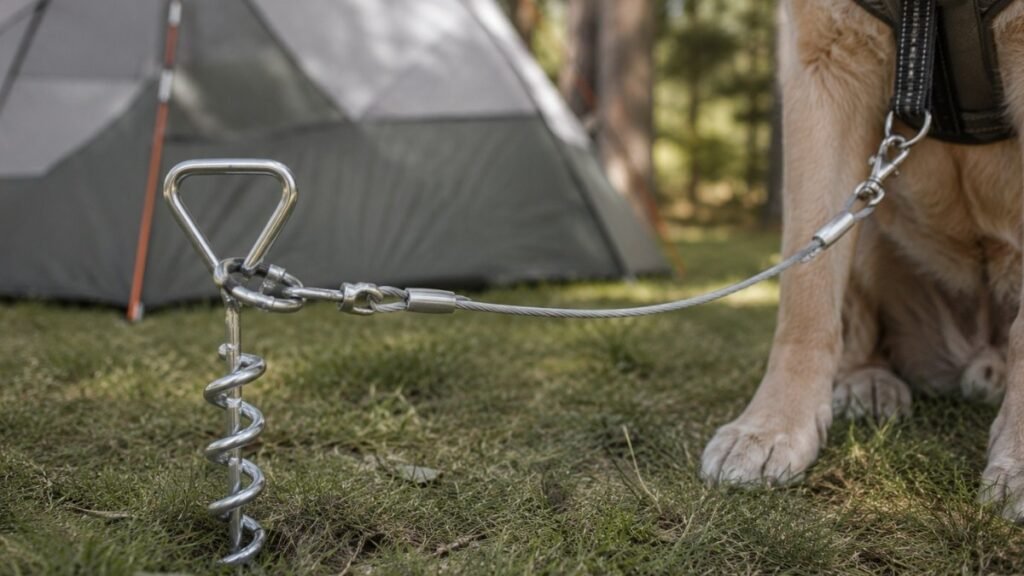
A tie-out allows you to secure your dog at camp without holding the leash — which is necessary any time you need both hands for camp tasks.
Corkscrew stake: The most common tie-out method. A spiral metal stake that screws into the ground, with a cable that clips to your dog’s harness or collar. Works well in soft to medium soil. Important note: attach to a harness, not a collar — a dog that hits the end of the cable running will take the force on their chest instead of their neck.
Runner line: More work to set up, more freedom for the dog. Tie a long rope or cord between two trees. Thread a shorter leash through a carabiner that slides along the rope. The dog has the run of the space between the trees rather than a fixed radius. Better for energetic dogs that get restless on a short stake.
Car tire anchor: Park one tire over a carabiner or D-ring attached to your leash. The weight of the car holds it. No stake needed, works on any surface. Particularly useful at campgrounds with hard or rocky ground.
Tree restrictions: Many campgrounds prohibit tying dogs directly to trees because it can damage bark. If this is the case, the stake or car tire method is the appropriate alternative.
Why Squeaky Toys Are a Terrible Campground Idea
This comes up repeatedly in dog camping communities and the collective experience is consistent: squeaky toys at a campground are a problem.
The squeaking triggers attention and excitement responses in other dogs — which means every dog within earshot is now alerted and possibly triggered. Your neighbor’s dog hears a squeaky 40 feet away and immediately wants to investigate. At a close-proximity campground with families and dogs in all directions, a squeaking toy every 30 seconds is a significant social disruption.
Bring silent toys — a rubber chew, a tug rope, a ball that doesn’t squeak. Your campground neighbors will appreciate it, and your dog will have just as much fun.
Campground Etiquette Every Dog Owner Should Know
Bad dog camping etiquette is one of the most common complaints at campgrounds, and most of it is preventable. Being the dog owner other campers don’t resent is mostly about awareness.
Leash Rules
The rule at virtually every developed campground: dogs must be on a leash at all times outside your campsite, and often within it. The standard maximum leash length is 6 feet. Retractable leashes are technically leashes, but at full extension (16 feet), they give your dog enough range to reach neighboring campsites, the campfire, other dogs, and anything else in the immediate area. Most campgrounds that see regular problems with dog incidents trace them back to retractable leashes.
Use a standard 6-foot leash. It keeps your dog genuinely close and prevents most of the situations that create problems between dogs, campers, and wildlife.
Keeping Barking Under Control
Dogs bark at campgrounds. This is normal. Sustained, ongoing barking — especially during quiet hours — is the thing that makes you genuinely unpopular.
A technique that works surprisingly well for reactive dogs: the visual barrier method. Open your car door or hang a tarp as a visual barrier between your dog and whatever they’re reacting to. Dogs that bark at things they can see often calm down significantly when the visual trigger is removed. It doesn’t fix the underlying reactivity, but it manages the behavior at camp effectively.
For dogs that bark at movement and sound, positioning the tie-out so your dog is facing away from the main campground traffic area reduces stimulus significantly.
High-value treats are your redirection tool. When you see your dog orienting toward something that usually triggers barking, ask for attention and reward before the bark starts. This requires actually watching your dog — which is another reason to have them occupied or contained during times when you’re focused on other tasks.
Respecting Wildlife and Other Campers
Don’t let your dog approach other campers or other dogs without explicit permission. Not every person at a campground likes dogs, and not every dog you encounter wants to meet yours. “He’s friendly!” is not a substitute for asking.
Keep your dog out of other people’s campsites. This sounds obvious until your dog decides their tent is infinitely more interesting than yours.
Don’t allow your dog to approach wildlife. This isn’t just a courtesy — it’s a safety issue. Wildlife encounters that go wrong often involve a dog that was “just trying to investigate.”
Leave No Trace with Dogs
Poop bags aren’t optional. Pick up every time, in every location — on trail, at the campsite, in the parking area. Carry the bags out; don’t leave them on the trail to “pick up on the way back” (this is how bags of dog waste end up left at trailheads indefinitely).
Don’t let your dog dig holes at the campsite. Don’t allow them to damage vegetation. These are basic Leave No Trace principles that apply equally to dogs.
Helping Your Dog Sleep Comfortably Inside the Tent
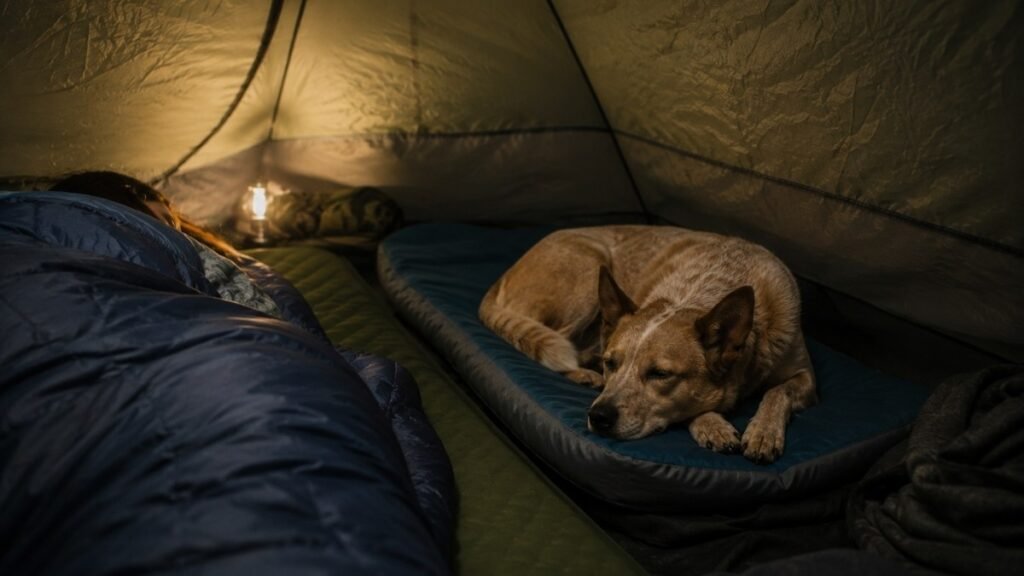
This section gets more attention in this guide than most other camping-with-dogs articles give it, because it’s the thing that most determines whether a camping trip with your dog is enjoyable or miserable. A dog that settles at night makes camping easy. A dog that doesn’t makes it exhausting.
Should Dogs Sleep Inside or Outside?
Inside. Almost always. Here’s why.
Outside: your dog is exposed to temperature drops, wildlife sounds at close range, and the general unpredictability of an unfamiliar environment. A dog tethered outside overnight will alert-bark at every sound — raccoons, other campers returning to their sites, wind in branches — and everyone in the vicinity will know about it.
Inside the tent: your dog has a defined, enclosed space. You’re present. The temperature is more stable. Most dogs settle significantly more quickly inside the tent than outside, because they’re with their person in a smaller, more manageable environment.
The trade-offs (claw damage to tent floors, dog hair everywhere, reduced sleeping space) are real but manageable with the right preparation — covered below.
Why Closing the Rain Fly Helps Anxious Dogs
This is one of those things that sounds odd until you try it and discover it actually works. An anxious dog in a tent with the fly down — enclosed, darker, more den-like — often settles much more quickly than the same dog in a tent where the fly is partially open and they can see movement outside.
The rain fly reduces visual stimulation and creates a more enclosed feeling that many dogs find calming. If you have a dog that’s alert and unsettled in the tent early in the night, try fully closing the fly and waiting 10–15 minutes. The difference is often significant.
Protecting Your Tent Floor from Claws
Dog claws and tent floors have a complicated relationship. A dog that’s spinning, kneading, or adjusting position will gradually scratch a tent floor over time — and a dog that’s startled or jumping up can do damage quickly.
Prevention:
- Place your dog’s sleeping mat or a folded blanket in their specific area of the tent — this provides a physical layer between their nails and the tent floor
- Trim nails before any camping trip
- Tent footprints work double duty: protecting the floor from below and (if placed inside under your dog’s area) from above
If your dog tears the tent despite this: duct tape is the field repair for small punctures and tears. Tent repair tape (sold at outdoor retailers for a few dollars) holds better for larger issues.
Keeping Your Dog Warm on Cold Nights
Dogs lose body heat to the ground just like humans do. A dog sleeping directly on a tent floor in cold conditions will be cold, will eventually be uncomfortable, and will communicate that discomfort — usually by moving around and disturbing the rest of the tent.
A dog sleeping mat or folded blanket provides insulation from the ground. For genuinely cold nights, a dog-specific sleeping bag (they exist and work well) or an extra fleece blanket over your dog makes a meaningful difference.
Signs a dog is cold at night: shivering, seeking to press against you for warmth, restlessness. If you’re seeing these, add insulation.
The “Leash Around Your Foot” Trick
This one comes from Reddit dog camping communities and it works exactly as described.
At night, after your dog is settled in the tent, loop the end of their leash loosely around your ankle or wrist. You don’t need to hold it — just loop it so you’d feel movement if your dog got up and moved toward the tent door.
This prevents two specific problems: a dog that scratches open a tent zipper while you’re asleep and wanders into the campground, and a dog that hears something outside and darts toward the door before you have time to respond. It’s a passive safety measure that requires no active effort after the initial setup.
Trail & Camp Safety: Common Outdoor Hazards for Dogs
Heat Exhaustion
Signs: Excessive panting, drooling more than usual, glazed eyes, stumbling, vomiting. What to do immediately: Move to shade. Offer water — don’t force it. Apply cool (not cold) water to paws, belly, and neck. Fan to increase evaporation. When to leave camp: If your dog doesn’t improve within 15–20 minutes of cooling measures, or if they collapse, become unresponsive, or show any signs of disorientation. Heat stroke in dogs can progress to organ failure quickly. This is an emergency vet situation.
Prevention: Don’t hike during peak heat hours (typically 11am–3pm). Carry more water than you think you need. Watch for early signs — a dog that’s slowing down and panting heavily is telling you to stop.
Ticks
Signs: Ticks are found by running your hands through your dog’s coat after any time in woods or grass. Focus on ears, around the eyes, between toes, under the collar, and in armpits. What to do immediately: Use a tick remover tool, not tweezers — grip as close to the skin as possible and pull straight out without twisting. Clean the area with antiseptic. Save the tick in a small container if you want it identified. When to leave camp: If the bite site becomes significantly swollen, red, or warm in the days following, consult your vet. Watch for signs of tick-borne illness (lethargy, fever, reduced appetite) in the 1–3 weeks following the trip.
Poisonous Mushrooms
Signs of ingestion: Drooling, vomiting, lethargy, stumbling within hours of eating. What to do immediately: If you saw your dog eat a mushroom and are unsure if it’s safe, call ASPCA Animal Poison Control (888-426-4435) or your vet immediately. Don’t wait for symptoms. When to leave camp: Immediately if you suspect mushroom ingestion. Mushroom toxicity can be delayed and severe.
Prevention: Keep your dog on a leash in mushroom-prone areas and watch what they’re sniffing on the ground.
Dirty Water and Giardia
Dogs that drink from streams, ponds, or standing water can contract Giardia — a parasitic infection that causes vomiting and diarrhea and requires veterinary treatment.
Prevention: Bring enough clean water for your dog and use a portable water filter (most human hiking filters work for dogs) if refilling from natural sources. Signs: Diarrhea (sometimes bloody), vomiting, lethargy — usually 1–3 weeks after exposure. When to see a vet: Any time your dog has persistent diarrhea or vomiting after a camping trip.
Sharp Rocks and Injured Paw Pads
Rocky terrain, sharp gravel, and hot pavement can all cause paw pad cuts or abrasions. Dogs don’t naturally signal paw pain the way humans signal foot pain — watch for limping, stopping frequently, or excessive licking of a paw.
What to do immediately: Clean the cut with saline, wrap with gauze and bandage tape to keep debris out, and limit activity for the rest of the trip. When to leave camp: Deep cuts that won’t stop bleeding, significant swelling, or any paw injury that prevents weight-bearing needs veterinary attention.
Nighttime Camping: The Things Most First-Time Dog Owners Forget
This is the section most camping-with-dogs guides skip, and it’s where a lot of first-timers get caught off guard.
LED Collars
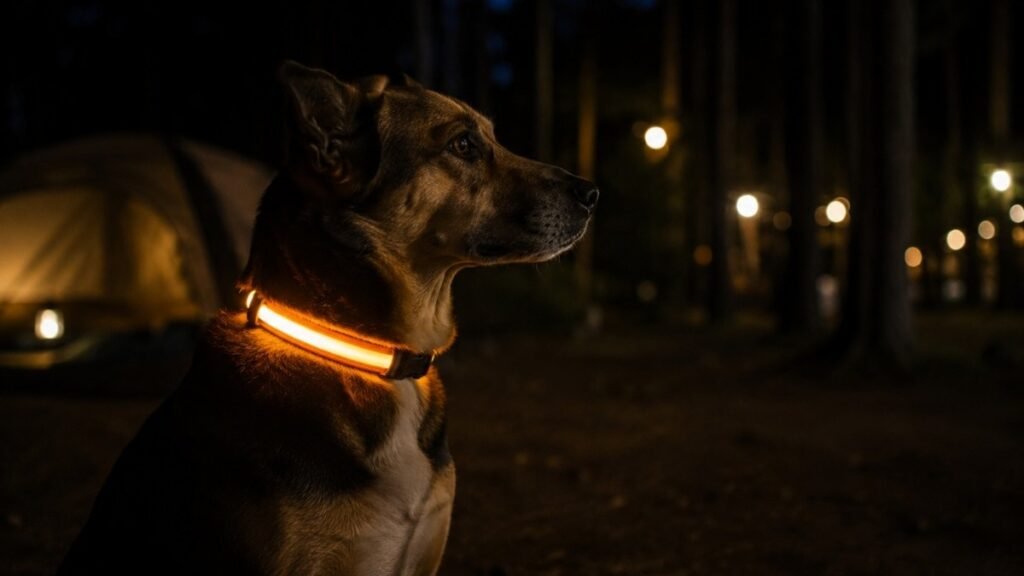
A dog that’s not immediately visible in a dark campground — between your site and the bathroom, near the campfire, or in the parking area — is a hazard to themselves and other campers. LED collars and clip-on blinky lights solve this at minimal cost ($8–15 for a clip-on, $20–30 for a full LED collar).
Put it on before it’s dark. Don’t wait until you can’t find it. This is the first thing that goes into the dog camping bag after a trip where you forgot it and spent 20 minutes in the dark using your phone flashlight to follow your dog around the campground.
Campfire Safety
Dogs are curious about fire in unpredictable ways. Some couldn’t care less. Others are drawn toward it. Keep your dog on a short leash or close tie-out near an active fire, and position yourself between the fire and your dog. Burns to nose and paws happen quickly and are painful.
Watch for your dog approaching the fire ring after the fire is out — coals retain heat for hours and ash can contain hot embers that aren’t visible in the dark.
Wildlife at Night
Raccoons, possums, skunks, and deer all move through campgrounds at night. Most dogs will alert to these with varying levels of urgency. Skunks are the specific concern — a dog that gets skunked in a campground at 1am is a memorable experience for everyone involved, including your tent neighbors. Keeping your dog on leash after dark and not letting them investigate every rustling sound prevents this particular adventure.
Thunderstorms
Dogs that are noise-averse or thunder-phobic are significantly more distressed in a tent during a storm than they would be in a familiar home environment. The enclosed tent amplifies sound, and there’s no familiar hiding spot.
If your dog has a significant thunder phobia and you’re camping in a region or season where storms are common, have a plan before you go: a thunder shirt, calming supplements (check with your vet), or the willingness to sit in the car (which provides better insulation from sound) during the worst of a storm.
Fireworks
If your trip falls near a holiday when fireworks are likely in the area — July 4th, New Year’s — research whether the campground or surrounding area typically has displays. A dog that handles campfire sparks fine may have a completely different reaction to fireworks at 10pm. Have a plan.
Emergency Crate Setup
A portable soft crate that folds flat is worth considering for any dog that does better in an enclosed space. It provides a defined “your space” inside the tent, keeps the dog contained if you need to get up in the night, and many dogs actually settle faster in a crate than loose in a tent. A collapsible soft crate weighs 3–5 lbs and takes up minimal car space.
Budget-Friendly Camping Gear That Actually Makes Life Easier
At TrailNexo, we don’t recommend gear because it’s expensive. We recommend it because it solves real problems at a price that makes sense. Here’s the honest breakdown for dog camping gear.
Items Worth Buying
Mudbuster paw cleaner ($15–25): The single item that has the highest before/after impact on camping comfort. Without it, muddy paw cleanup involves wrestling a dog who doesn’t understand why this is happening while water goes everywhere. With it: fill with water, insert paw, twist, done. Four paws in under two minutes. The difference between a clean sleeping bag and a tent that looks like a mud wrestling arena.
LED collar or clip-on light ($8–30): Already covered above. Non-negotiable for nighttime. The clip-on version at $8–12 works just as well as the full collar and fits any existing collar.
Tick remover tool ($6–10): Significantly better than tweezers for complete tick removal. A two-pack costs less than a cup of coffee and handles hundreds of removals.
Corkscrew tie-out stake ($10–15): The foundation of a functional camp setup with a dog. The ability to secure your dog hands-free while you set up camp changes everything.
Cheap DIY Alternatives
Dry bag for dog food: A ziplock gallon bag works identically to a dedicated “dog food travel container” that costs $25. Close it tight and store in your cooler or car.
Runner line: A length of paracord ($8 for 50 feet) between two trees with a carabiner from a hardware store ($3–4) builds a runner line for under $15 that works identically to purpose-built runner line systems sold for $30–40.
Dog sleeping pad: A yoga mat or folded moving blanket protects the tent floor and provides ground insulation for less than $5. A purpose-built dog camping mat solves the same problem for $40–80.
Gear You Can Skip
Dog-specific water bottles: Your dog can drink from your collapsible bowl just fine. A dedicated dog water bottle with a flip-out bowl is convenient but not necessary.
Fancy dog backpack: On a car camping trip where your dog isn’t carrying gear, a dog backpack is unnecessary weight for your dog and expense for you. Consider it for backpacking trips, not your first car camp.
Dog booties: Unless you’re in terrain with specific hazards (extreme heat, sharp shale), most dogs don’t need booties. Watch paws, carry first aid materials for cuts, and skip the boots unless your dog’s specific terrain requires them.
Rookie Mistakes That Can Ruin a Camping Trip With Your Dog
Bringing an untrained puppy to a busy campground. A puppy that barks at everything, pulls constantly, jumps on strangers, and has limited impulse control is going to struggle in a campground environment. Start with quiet, low-stimulation outdoor environments and build toward camping over time.
Letting dogs drink stream or lake water. Giardia is real and the treatment isn’t pleasant. Bring water or filter it. Don’t let your dog drink from standing water or slow-moving streams.
Forgetting vaccination proof. Some campgrounds check. You may not be allowed in. Keep a copy in your camping bag permanently.
Long retractable leashes. They give dogs enough range to reach other campsites, other dogs, campfires, and wildlife. They create a constantly-changing leash radius that’s hard for other dogs to read. Use a standard 6-foot leash.
Leaving food unattended near your dog. At home, your dog knows the rules about food. At a campsite with novel smells, stimulation, and reduced supervision, the rules are less clear to them. Coolers, food bags, and the camp kitchen area need to be genuinely inaccessible, not just in a location that “should be fine.”
Assuming every campground allows dogs. Check before booking. Not every trail within a campground is dog-permitted. Not every section of a national park allows dogs. A quick check of the specific campground’s pet policy page prevents arriving to find your dog isn’t allowed where you planned to hike.
Using a collar-only setup in new terrain. Dogs spook. A dog in new terrain with unfamiliar stimulation that pulls or bolts unexpectedly can back out of a collar faster than you can react. A harness makes escape significantly harder. Use a harness for camping trips, especially the first one.
FAQ
Q: Can every dog go camping? Most dogs can camp with appropriate preparation and the right environment — but not every dog is ready for their first camping trip immediately. Dogs that do best: those with basic leash manners, the ability to settle when asked, and some exposure to outdoor environments. Dogs that need more preparation first: highly reactive dogs, very young puppies, dogs with significant anxiety, or senior dogs with mobility limitations. Start with day trips to parks and natural areas before committing to a full overnight.
Q: Should my dog sleep inside the tent or outside? Inside, almost always. A dog sleeping outside overnight in an unfamiliar environment will alert-bark at every sound — raccoons, other campers, wind — and nobody at the campground will sleep well. Inside the tent, your dog has a defined, enclosed space with you present, and most dogs settle significantly faster. The trade-off is some dog hair and reduced space, both of which are manageable.
Q: How long should my dog’s leash be at a campground? Six feet is the campground standard and the maximum at most developed sites. Retractable leashes at full extension give dogs enough range to reach neighboring sites, other dogs, and campfires — they create most of the dog-related problems at campgrounds. A standard 6-foot leash keeps your dog close enough for you to manage any situation quickly.
Q: How do I check my dog for ticks after hiking? Run both hands through your dog’s entire coat, section by section. Ticks are small but detectable by feel — you’re looking for small bumps that weren’t there before. Focus on: ears (inside and the fold), around the eyes, under the collar, armpits, between toes, and around the tail base. These are the warm, sheltered areas ticks prefer. Do a full check every time your dog comes back from a trail or wooded area.
Q: How can I stop my dog from barking at the campsite? The most effective approach: prevention through visual barriers (open a car door or hang a tarp between your dog and the trigger) combined with high-value treat redirection before the bark starts. For dogs that alert-bark at sounds, positioning the tie-out away from main traffic areas reduces stimulus. A frozen KONG during high-stimulation periods (setup, mealtimes, neighbor activity) occupies attention before barking starts. Sustained barking during quiet hours is grounds for being asked to leave a campground — take it seriously.
Q: What should I do if my dog tears the tent? For small punctures and scratches: duct tape on both the inside and outside of the damage holds through the rest of a trip. For larger tears: tent repair tape (available at outdoor retailers for a few dollars) provides a more durable field fix. On returning home, most tent manufacturers sell patch kits, and outfitters like REI offer tent repair services. Prevent future damage with a sleeping mat or folded blanket in your dog’s tent area, and trim nails before trips.
Q: What camping gear is actually worth buying for dogs? The items with the highest real-world impact: a Mudbuster paw cleaner ($15–25), an LED collar or clip-on blinky light ($8–30), a tick remover tool ($6–10), and a corkscrew tie-out stake ($10–15). These four items cost under $80 total and solve the majority of practical dog camping problems. Everything else — dog-specific water bottles, fancy food containers, dog booties for regular terrain — is optional.
One Last Thought
Your first camping trip with your dog probably won’t be perfect—and it doesn’t have to be.
Maybe your tent setup takes twice as long as planned. Maybe your dog barks at a passing squirrel, tracks mud into the tent, or insists on sleeping across your sleeping bag. Those little moments are part of learning how to camp together.
What matters most isn’t having the newest gear or the perfect campsite. It’s building your dog’s confidence one trip at a time, starting with simple adventures close to home, and creating outdoor memories you’ll both enjoy for years to come.
🏕️ TrailNexo Notes: Why This Guide Goes Beyond Basic Camping Tips
Camping with a dog isn’t just about packing an extra food bowl or buying new gear. It’s about understanding how dogs respond to unfamiliar environments, campground etiquette, weather changes, and outdoor hazards before they become problems.
Instead of relying on one source, this guide combines practical camping advice, outdoor safety recommendations, veterinary guidance, and real-world experiences shared by dog owners to help first-time campers prepare with confidence.
This guide was developed using information from:
🐕 Dog Behavior & Campground Experience
Practical lessons shared by experienced campers and dog owners on handling barking, camp setup, nighttime routines, and common first-trip challenges.
🩺 Pet Health & Outdoor Safety
General guidance from veterinary organizations and public health resources covering tick prevention, heat safety, hydration, poisonous plants, and emergency preparedness.
🏕️ Campground Rules & Leave No Trace
Best practices from campground policies and Leave No Trace principles for responsible camping with pets and respecting other campers.
🎒 Beginner-Friendly Gear & Practical Solutions
Real-world gear recommendations focused on affordable, useful equipment that solves common camping problems instead of encouraging unnecessary purchases.
Camping with your dog isn’t about having the most expensive equipment.
It’s about understanding your dog’s needs, preparing for the unexpected, and building confidence one trip at a time.
Continue building your camping knowledge:
Every camping trip teaches you something new. These beginner-friendly guides can help you build your outdoor skills, pack smarter, and feel more confident on your next adventure.
- Camping for Beginners: The Complete Guide
- The Complete Camping Checklist
- Car Camping for Beginners
- Outdoor Safety for Beginners
- How to Camp in the Rain
At TrailNexo, we believe outdoor adventures should feel welcoming — not overwhelming. That goes for first-time hikers, first-time campers, and first-time dog campers equally. The goal is always the same: practical advice, honest gear recommendations, and real-world tips that help ordinary people — and their dogs — spend more time outside with confidence.
We reviewed recommendations from veterinary organizations, public land agencies, and experienced campers to ensure the advice is practical as well as evidence-informed.