
What lumens you actually need, why red light matters more than you think, and the beginner-friendly picks that experienced hikers actually use.
Key Takeaways
- For most beginner hikers and campers, 200–300 lumens is the ideal brightness — bright enough to navigate trails safely, without draining your battery in two hours
- Red light mode is not optional — it preserves your night vision around camp and lets you check your map or find your shoes without blinding your tentmates
- Rechargeable headlamps are the best choice for regular users (once a month or more); battery-powered models are better as emergency backups or infrequent use
- A good beginner hiking headlamp costs $25–45 — you don’t need to spend $100+ to get reliable, practical performance
- The lock mode (preventing accidental activation in your bag) is the most underrated feature — without it, you’ll discover your headlamp is dead exactly when you need it most
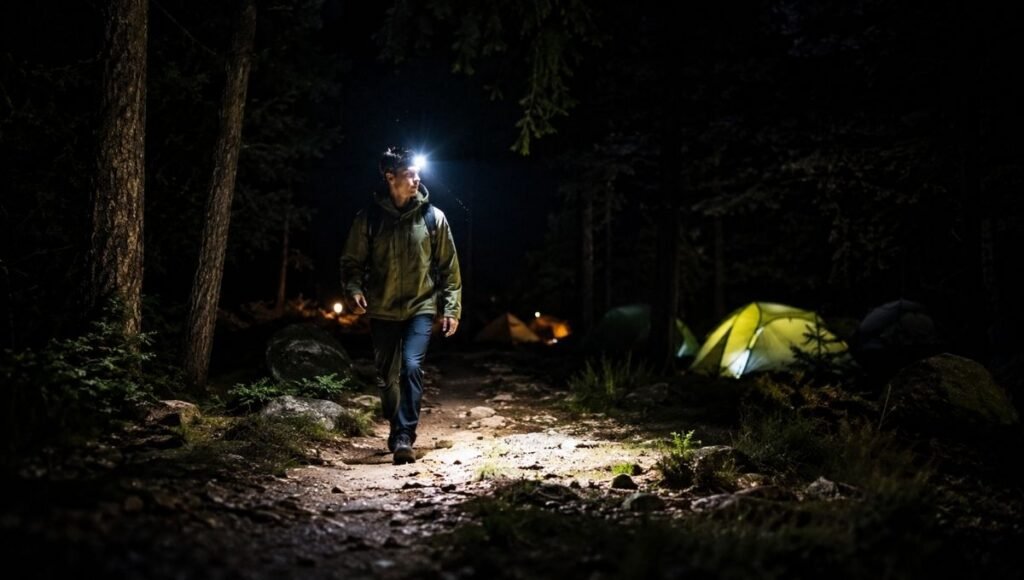
Most people assume a headlamp is a headlamp. You strap it on, it makes light, end of story. Then they do their first real camping trip — wake up at 2am needing to use the bathroom, reach for their phone flashlight, shuffle out into the dark with one hand occupied holding a phone and the other trying to avoid walking into a tent — and suddenly understand why every experienced camper carries an actual headlamp.
The hands-free factor alone is worth it. But there’s more to choosing the right headlamp for hiking and camping than just “any headlamp.” The wrong one — too dim, no red light, no lock mode, batteries that die in the cold — creates problems at exactly the moments when you want zero problems. The right one fades into the background of your kit and just works, every time, without you thinking about it.
This guide covers everything a beginner needs to know: how many lumens you actually need, why red light mode is more important than it sounds, whether to go rechargeable or battery-powered, and which specific headlamps are worth your money at different price points. No unnecessary jargon, no lists of specs you don’t care about — just the information you need to make a good decision.
Headlamp vs Flashlight: Why Hands-Free Lighting Changes Everything Outdoors
Before getting into specs, it’s worth understanding why a headlamp specifically — not a flashlight, not your phone — is the right tool for outdoor activities.
The obvious reason is hands-free use. When you’re setting up a tent in the dark, cooking dinner at the campsite, navigating a trail after sunset, or making a midnight bathroom trip, having both hands available isn’t a convenience — it’s a safety requirement. Flashlights work when you can hold one thing and do nothing else with that hand. Which is almost never the situation you’re actually in.
The less obvious reason is beam direction. A headlamp points wherever you’re looking. You turn your head to check the map, and the light follows. You look at the trail ahead, the light follows. A flashlight requires you to actively aim it, which means one hand is always managing the light rather than managing whatever you’re doing.
For camping specifically, there’s a third reason that doesn’t become obvious until your first night outside: the red light mode. More on this below — but it’s significant enough that it should be one of your primary selection criteria, not an afterthought.
How Many Lumens Do You Need for Hiking and Camping?
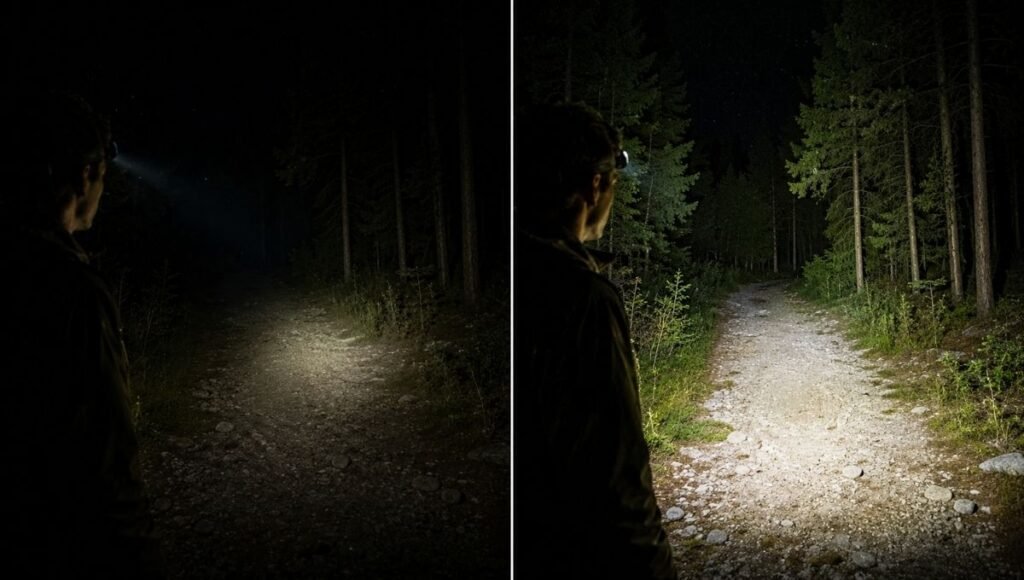
This is the question that causes the most confusion in headlamp shopping, partly because the number on the box ranges from 50 to 3,500+ lumens with no obvious guidance for what any of it means in practice.
Here’s the honest breakdown:
100–150 lumens: Adequate for close-range camp tasks — finding things in your tent, reading a map, cooking at the picnic table. Not enough for confident trail navigation in the dark.
200–300 lumens: The sweet spot for most beginner hikers and campers. For most hikers, 300 lumens feels strong and dependable — it pushes the shadows back far enough to react to trail obstacles without obliterating battery life by midnight. This is the range you want for general day hiking (as a safety backup), occasional night hiking on established trails, and all camp tasks.
400–500 lumens: Useful if you’re regularly hiking after dark, in challenging terrain, or at a faster pace where you need to spot obstacles further ahead. Overkill for most beginner use cases.
500+ lumens: Trail running, technical climbing, search and rescue. Not what most beginners need.
The important caveat about “max lumens”: Almost every headlamp has multiple brightness settings. A headlamp rated at 400 lumens max will typically also have a 100-lumen mode that you’ll use 80% of the time, with the high setting available when you need it. The “max lumens” figure is what makes the box look impressive, but the battery life at max is often 1–2 hours — the low setting is what you’ll actually use for sustained camp tasks and trail walking.
The practical recommendation for beginners: A headlamp with 200–400 lumens max and multiple brightness settings covers every beginner use case. Don’t pay extra for 1,000+ lumens unless you have a specific reason you’ll need them.
Why Red Light Mode Matters More Than You Think
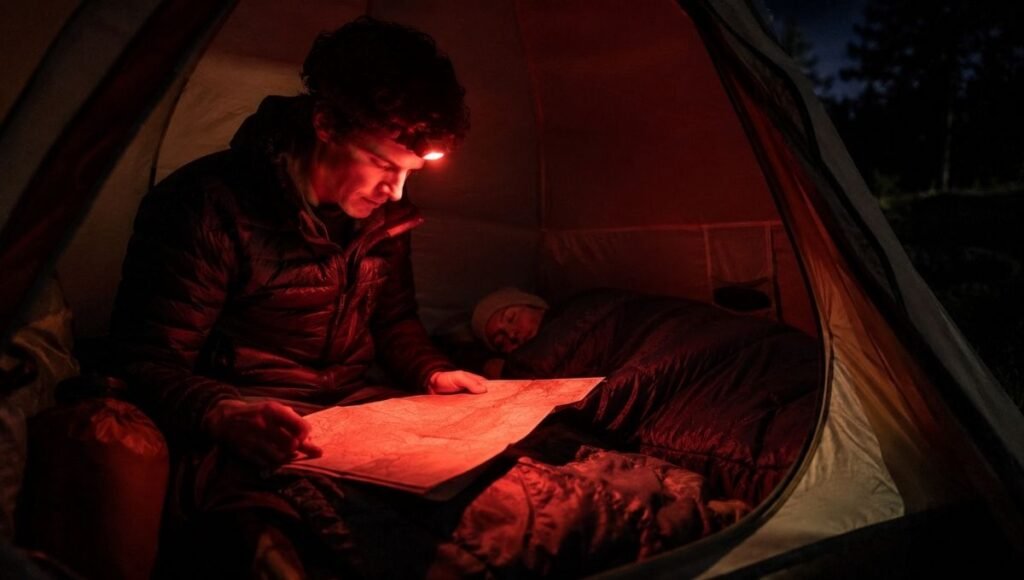
This is the feature that almost every experienced camper says they didn’t think they needed until the first time they needed it — and then they never bought a headlamp without it again.
Here’s the situation: it’s 2am. You need to find your headlamp, unzip the tent without waking your tentmate, and navigate to the bathroom. You turn on your headlamp on white mode.
What happens next: your pupils — which had been fully dilated to adjust to the darkness — immediately constrict in response to the bright white light. Your tentmate wakes up. And then when you turn the headlamp off, you’re essentially blind for 20–30 seconds while your eyes readjust to the dark.
Red light solves this on multiple levels. Red light has a wavelength that does not disrupt your “night vision” — when you need to exit the tent at midnight or look at a map, using red light will not disturb your eyes’ adaptation to darkness. Additionally, red light does not dazzle the eyes of your camping friends and attracts fewer insects than white light.
In practice: red light for camp tasks at night (finding gear, reading, bathroom trips), white light for actual navigation and trail use. If there’s one feature to prioritize beyond basic brightness, it’s this one.
Editor’s note: Red light also makes you significantly less annoying to other campers at a shared campground. White light pointing around a campsite after dark is genuinely disruptive to people trying to sleep. Red light is a courtesy, not just a technical feature.
Rechargeable vs Battery-Powered Headlamp: Which Is Right for You?
This is one of the most common questions in headlamp shopping, and the honest answer is: it depends on how you camp.
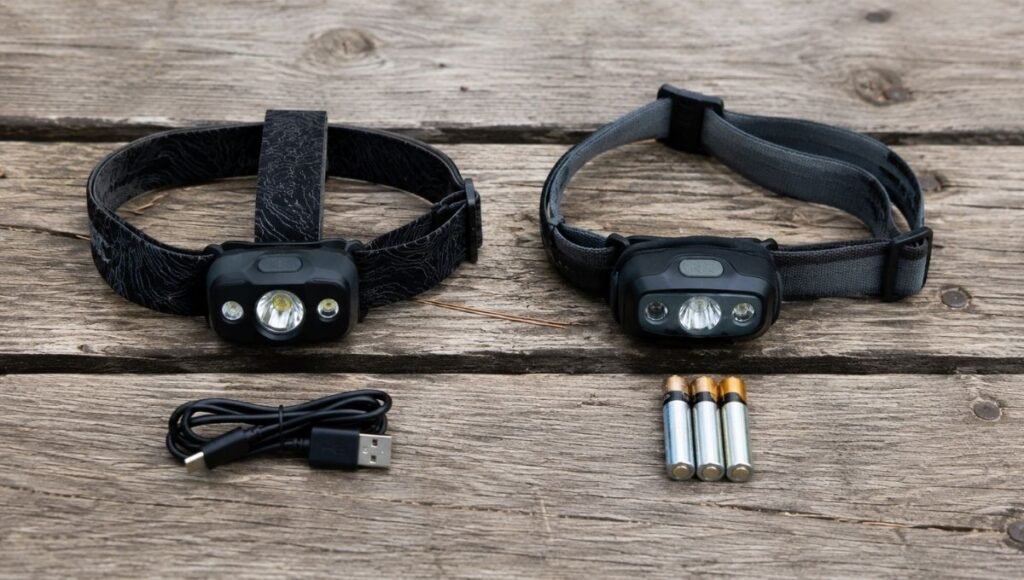
Rechargeable Headlamps
Pros:
- Charge via USB — same cable as your phone in most cases
- No ongoing battery cost after initial purchase
- More environmentally friendly
- Battery level indicator shows remaining charge (most models)
- Can charge from a portable power bank in the field
Cons:
- Dead battery requires access to charging — not always possible on multi-day trips
- Cold weather significantly reduces battery performance
- If you forget to charge before a trip, you’re stuck
Best for: Regular hikers and campers (once a month or more), day trips, camping with vehicle access, anyone who wants to minimize waste and ongoing cost.
Battery-Powered Headlamps (AAA/AA)
Pros:
- Fresh batteries are available anywhere — gas stations, convenience stores, outdoor shops
- Battery swap in the field takes 30 seconds
- Better cold-weather performance (lithium AA batteries especially)
- No “forgot to charge” problem
Cons:
- Ongoing cost of batteries
- Less environmentally friendly without rechargeable batteries
- Battery level can be harder to gauge (some models have indicators, most don’t)
Best for: Infrequent campers, emergency backup, cold-weather camping, multi-day trips without charging access.
The hybrid solution: Many experienced campers use rechargeable headlamps as their primary but keep a pack of lithium AAA batteries in their kit as backup. Some models (like the Black Diamond Spot) accept both rechargeable battery packs and standard AAAs, which is the most flexible setup.
The 5 Features That Actually Matter on a Beginner Headlamp
Beyond lumens and battery type, these are the features worth paying attention to:
1. Red Light Mode
Covered above — non-negotiable for camping use.
2. Lock Mode (Prevents Accidental Activation)
This is the most underrated feature on any headlamp. Without a lock mode, your headlamp can turn on accidentally when it’s bouncing around in your pack — and by the time you need it, the battery is dead. Lock mode (usually activated by holding a button for 2–3 seconds) prevents this completely. Check that any headlamp you buy has it.
3. Tilt/Pivot Head
A headlamp that angles downward lets you illuminate the ground directly in front of you (for trail walking) or your hands (for camp tasks) without pointing the beam at eye level. Fixed-beam headlamps that only point straight ahead are significantly less versatile. This feature is standard on most reputable brands.
4. Waterproof Rating (IPX4 or Higher)
Rain, morning condensation, sweat — headlamps encounter moisture regularly even on “dry” trips. An IPX4 rating (water resistant to splashing from any direction) is the minimum for outdoor use. IPX6 and IPX7 are more robust. Look for this in the specs — “water resistant” without a specific rating is often marketing language.
5. Weight and Comfort
A headlamp that’s uncomfortable to wear for more than 20 minutes becomes a problem on longer hikes. For beginner day hikers, anything under 3 oz is fine. For overnight campers who’ll wear it for extended periods, look for a wider headband and rear stabilizer strap for better weight distribution.
Best Headlamp for Hiking: Picks by Budget

Best Under $30: Budget-Friendly and Genuinely Reliable
Ozark Trail 500-Lumen LED Headlamp (~$15–20) This Walmart-exclusive option is consistently recommended as the best budget entry point. At 500 lumens max with multiple modes including red light, it performs significantly above its price point. Battery-powered (3 AAA), IPX4 water resistant, and lightweight. The battery life on high is short (as with all 500-lumen lights), but the low mode is efficient and practical.
What you’re getting: A headlamp that genuinely works for beginner camping and short hikes. Not as durable as premium options, but for occasional use it’s hard to argue with the price.
Best for: First-time campers who want to spend as little as possible, people who aren’t sure how much they’ll use a headlamp.
Best $25–45: The Beginner Sweet Spot
Black Diamond Spot 400 (~$35–45) The Black Diamond Spot is the most consistently recommended beginner headlamp across outdoor communities, and has been for years. The reasons are straightforward: 400 lumens max with a well-designed multi-mode interface, waterproof (IPX8), red light mode, lock mode, tilt head, and a battery level indicator. It runs on 3 AAA batteries and is also available in a rechargeable version (Spot 400-R, ~$50).
The Spot isn’t flashy, doesn’t have the highest lumen count, and isn’t the lightest option. What it is: reliable, well-built, intuitive to use, and backed by a 3-year warranty from a brand that’s been making outdoor gear since 1957.
Editor’s note: When nine out of ten experienced hikers in a forum thread recommend the same headlamp, that’s meaningful. The Black Diamond Spot’s reputation is earned through years of real-world use, not marketing.
Petzl Tikkina (~$20–30) A slightly simpler, lighter, more affordable option from another trusted outdoor brand. 300 lumens max, red light mode, simple one-button interface. Doesn’t have a lock mode on all versions — check before buying. Good choice for campers who want Petzl reliability at a lower price point than the Actik Core.
Best for: Regular beginner campers and hikers who want a reliable setup that’ll last several years.
Best $45–70: Rechargeable and Ready for More
Black Diamond Spot 400-R (~$50–60) The rechargeable version of the Spot above. Adds a USB-C charging port and integrated 1500mAh Li-ion battery while keeping the same feature set. The battery level indicator shows percentage remaining, so you know exactly what you’re working with before a trip.
Petzl Actik Core (~$55–65) The Petzl Actik Core accepts both the included rechargeable CORE battery and standard AAA batteries — giving you the flexibility of rechargeable with the emergency fallback of disposables. 450 lumens max, red light mode, compact and light. Widely recommended as the best of both worlds for hikers who want rechargeable convenience without completely giving up the AAA safety net.
Best for: Hikers who go out regularly and want rechargeable convenience without sacrificing the option to swap to standard batteries in the field.
Best Headlamp by Use Case
Best Headlamp for Day Hiking
Day hiking headlamps are primarily safety tools — you probably won’t need them, but you’ll be glad you have one if a hike takes longer than expected. Priority: lightweight and low-profile.
Recommendation: Black Diamond Spot 400 or Petzl Tikkina. Both are light enough to barely notice in your pack and provide enough output if you need them at dusk or dawn.
Best Camping Headlamp
Camp headlamps get used constantly — cooking, navigating to the bathroom, reading in the tent, organizing gear. Priority: red light mode, comfortable to wear for extended periods, and easy-to-use interface in the dark.
Recommendation: Black Diamond Spot 400-R or Petzl Actik Core. The rechargeable convenience matters when you’re using it multiple times per night over several days.
Best Budget Headlamp for Beginners
When you want reliable performance without significant investment while you figure out how much you’ll actually use it.
Recommendation: Ozark Trail 500-lumen (under $20) or Black Diamond Spot 400 ($35–45, AAA version). The Black Diamond is significantly better quality; the Ozark Trail is fine for occasional use.
The Headlamp Mistakes Most Beginners Make
These come from real camping community experience — the things that cause problems on first and second trips.
Mistake 1: Not using the lock mode. Your headlamp will turn on in your pack. It happens to almost everyone on their first trip. After discovering a dead headlamp at the campsite, every experienced camper religiously uses the lock mode. Before you pack your headlamp, hold the button until the lock activates.
Mistake 2: Always using max brightness. Max brightness is for navigation and emergencies. For reading in the tent, organizing your pack, or moving around camp, 30–50 lumens is completely adequate and extends battery life dramatically. Learn your headlamp’s low settings and use them.
Mistake 3: Not checking battery level before a trip. Check your headlamp the night before any outing. If it’s rechargeable, charge it. If it’s battery-powered, verify the battery level. Dead headlamps are an inconvenience at a campground and a safety issue in the backcountry.
Mistake 4: Using white light at night in camp. This is the “wake up the whole tent” problem. Default to red light for any camp task after dark, and only switch to white when you actually need distance visibility. Your tentmates and your own eyes will thank you.
Mistake 5: Forgetting that cold drains batteries faster. Rechargeable headlamps in particular lose significant capacity in cold temperatures — a headlamp that runs for 6 hours in mild conditions might run for 2-3 hours in below-freezing temperatures. For cold-weather camping, keep your headlamp inside your sleeping bag at night, and consider lithium batteries (which perform better in cold) for battery-powered models.
If You Only Have 5 Minutes to Decide
No time to research? Here it is:
Most beginners: Black Diamond Spot 400 (~$35–45, AAA version). Works everywhere, lasts for years, does everything you need.
If you want rechargeable: Black Diamond Spot 400-R (~$50–60) or Petzl Actik Core (~$55–65).
Tightest budget: Ozark Trail 500-lumen (~$15–20) from Walmart. Not as durable but functional for getting started.
Whatever you buy: verify it has red light mode and a lock mode. Those two features matter more than lumen count for most beginner camping situations.
When Your Headlamp Situation Becomes a Safety Issue
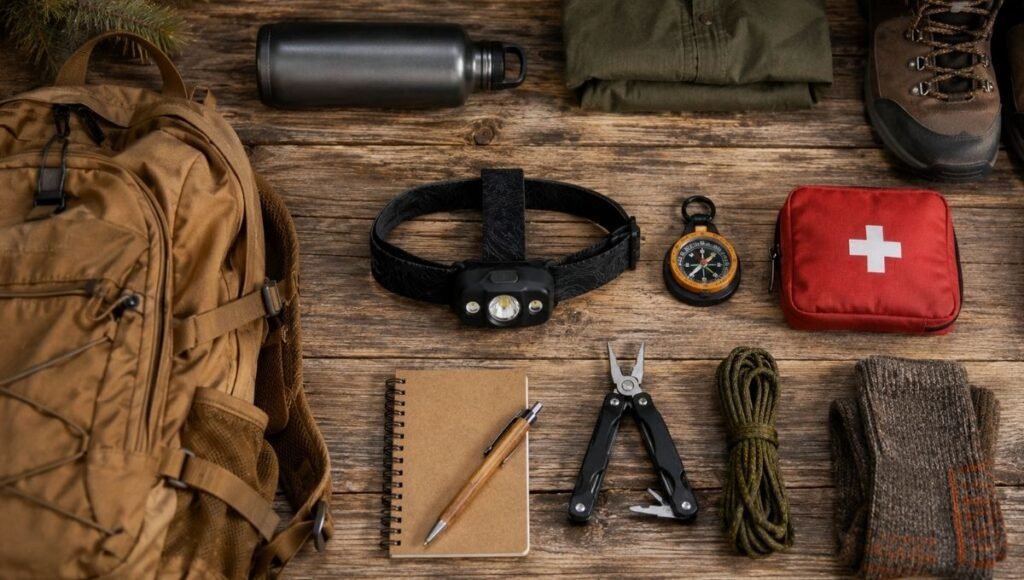
A headlamp failure is usually an inconvenience rather than a crisis — but there are situations where it’s more serious:
If you’re hiking after dark without a working light: Stop. Stay where you are. Use your phone flashlight conservatively to preserve battery. If you have cell signal, call for assistance. Attempting to navigate unfamiliar terrain without adequate light significantly increases injury risk.
If your headlamp dies at camp on a cold night: Use your phone flashlight sparingly. If there’s a campground host, they can usually help with spare batteries. This is why experienced campers keep spare batteries even with rechargeable headlamps.
Eye safety: Never look directly into a high-lumen headlamp. At 400+ lumens, direct eye exposure from close range can cause temporary visual disturbance. This is particularly relevant around camp when people are at face height.
FAQ: Real Questions About Hiking Headlamps
Q: How many lumens do I need for hiking? For most beginner hikers on established trails, 200–300 lumens is sufficient. This provides enough light to navigate safely without draining the battery in an hour. If you’re regularly hiking after dark or in challenging terrain, 300–500 lumens gives more visibility. Higher lumen counts (500+) are primarily for trail running or technical activities where speed requires longer light range.
Q: Is a rechargeable headlamp worth it? For regular campers and hikers (monthly or more), yes — the convenience of USB charging and the elimination of ongoing battery cost make it worthwhile. For occasional use (a few times a year) or as an emergency backup, battery-powered models are more practical since batteries don’t discharge when sitting in storage.
Q: What’s the difference between Black Diamond and Petzl headlamps? Both are high-quality outdoor brands with similar pricing and feature sets. Black Diamond tends to have a simpler interface and slightly more robust waterproofing on comparable models; Petzl tends to have more advanced lighting technology on higher-end models. For beginners, either brand is excellent — the specific model matters more than the brand name.
Q: Do I need a waterproof headlamp for hiking? Yes, at minimum IPX4 (splash-resistant). Rain, sweat, morning dew, and condensation are common in outdoor environments even on “dry” trips. A headlamp without meaningful water resistance is a liability rather than a reliable tool.
Q: Why does my headlamp die faster than expected? Three common causes: using high brightness when low would work fine (high lumens drain batteries dramatically faster), cold temperatures (which reduce battery capacity significantly), and leaving it on accidentally — which is why the lock mode is so important.
Light the Way Forward
The right headlamp for hiking and camping isn’t complicated to find, but it makes a real difference to how comfortable and safe you feel outside after dark. Start in the $25–45 range, get red light mode and a lock mode, and choose rechargeable if you’ll use it regularly.
Once you’ve used a good headlamp for a full camping trip, you’ll wonder how you ever managed with a phone flashlight. It’s one of those pieces of gear that feels minor until you have it — and then you don’t leave home without it.
Continue building your outdoor kit:
- The Complete Hiking Packing List for Beginners
- Best Lightweight Hiking Backpack for Beginners
- Hiking First Aid Kit: What to Pack
- Camping for Beginners: The Complete Guide
References
- FarOut Guides. How to Select the Right Headlamp — Lumens and Features Guide. faroutguides.com
- Fenix Lighting. Headlamp Lumens: How Many Do You Really Need? fenixlighting.com
- Switchback Travel. Best Headlamps — Tested and Reviewed. switchbacktravel.com
- American Alpine Club. Gear and Safety Recommendations for Outdoor Recreation. americanalpineclub.org
- National Park Service. Hiking Safety and Night Hiking Guidelines. nps.gov