
Let’s be real: waking up at 2 AM with teeth chattering isn’t exactly the “outdoor escape” you planned. Most people assume they need a bulky, battery-draining device to survive a cold night, but learning how to stay warm camping without a heater is actually about physics, not power outlets.
Whether you’re dealing with an unexpected cold front or you’re a minimalist looking to shed pack weight, these winter camping hacks will turn your tent from a refrigerator into a cozy sanctuary. It’s time to stop shivering and start mastering your tent heating safety through smarter habits.
The “Internal Heater”: Fueling Your Body for Warmth
Before you even unzip your sleeping bag, your survival starts with what you eat. Your body is a furnace; if you don’t give it fuel, the fire goes out.
Eat a High-Fat “Midnight” Snack
Digestion creates thermal mass. Eating a spoonful of peanut butter or a handful of walnuts right before bed forces your body to generate heat for hours. Avoid simple sugars that give you a quick spike and a long, cold crash.
The Hydration Paradox
You need to stay hydrated to circulate blood effectively, but don’t chug water right before bed. A full bladder is a “heat sink”—your body wastes massive amounts of energy keeping that liter of liquid at $37^{\circ}\text{C}$. If you have to pee, do it. Don’t hold it in and get colder.
The Hot Water Bottle: The Ultimate Survival Hack
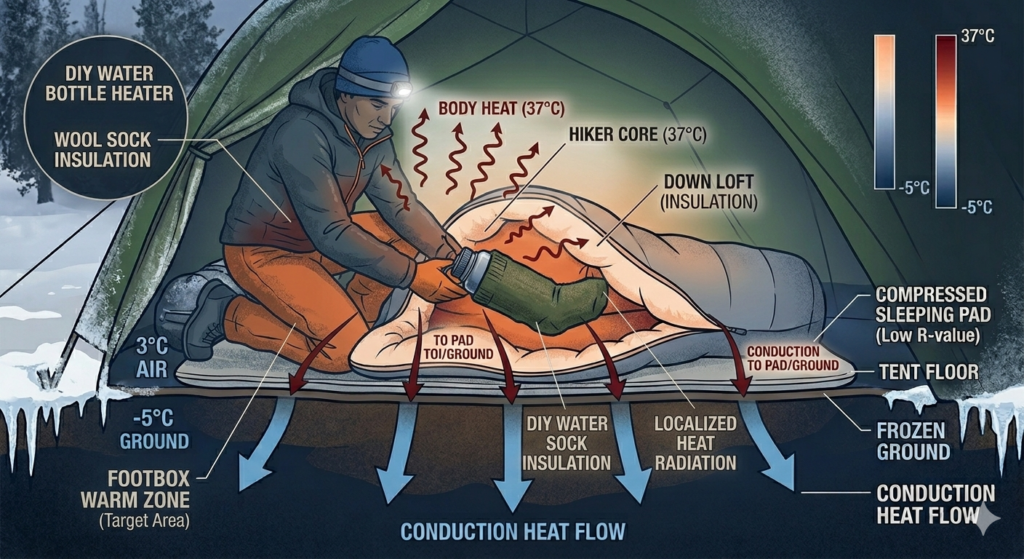
If I could only recommend one DIY camping heater, it’s the classic Nalgene bottle trick. It is safer than any propane heater and lasts for hours.
- Boil water and pour it into a leak-proof, BPA-free plastic bottle.
- Tighten the lid (double-check it!) and wrap it in a clean wool sock.
- Place it in your sleeping bag near your groin or armpits—where your major arteries are.
Site Management: Engineering a Warmer Tent
The air inside your tent is a resource. If there is too much of it, your body can’t heat it up.
Shrink Your Living Space
If you’re solo in a 3-person tent, you’re going to be cold. Use your extra gear, backpacks, and dry clothing to “wall off” the empty space around your sleeping pad. This reduces the air volume your body needs to warm.
The “Warm Rock” Technique
Find a few medium-sized stones (avoid river rocks as they can explode when heated!) and place them near the edge of your campfire. Once they are warm—not scorching—wrap them in a towel and tuck them into the corners of your tent. They act like ancient thermal batteries.
Clothing Hacks: What to Wear (and What to Burn)
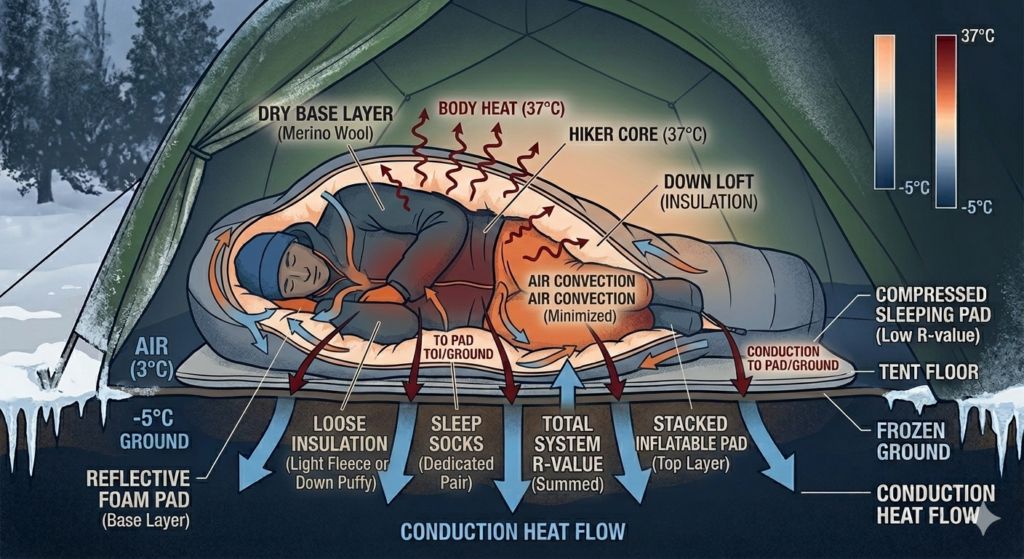
A common mistake is wearing everything you own inside the bag. This actually compresses the bag’s insulation and makes you colder.
The Dry Socks Rule
Even if your hiking socks feel “mostly dry,” they are damp with sweat. Dampness leads to conduction heat loss. Always keep a dedicated pair of thick wool socks in your sleeping bag that never leave the tent.
Cover Your Head and Neck
You can lose significant heat through your head. A fleece beanie is essential, but a neck gaiter is the secret weapon. It prevents the “bellows effect” where warm air escapes every time you toss and turn.
FAQ: Survival Myths and Safety
Q: Should I sleep naked in my sleeping bag to stay warmer?
A: No. This is a persistent myth. While you shouldn’t wear tight, restrictive layers, a set of dry, loose merino wool base layers provides an extra layer of trapped air that keeps you significantly warmer than bare skin.
Q: Is it safe to use a candle lantern for heat?
A: We strongly advise against it for tent heating safety. The risk of fire or carbon monoxide buildup far outweighs the negligible $1^{\circ}\text{C}$ of warmth it provides. Stick to the hot water bottle method.
Conclusion: Knowledge is Better Than a Heater
Staying warm is a skill, not a product. By combining the right fuel, the right bottle hack, and smart site management, you can comfortably survive sub-freezing temperatures without ever plugging in.
For more advanced safety protocols on cold-weather survival, refer to the National Outdoor Leadership School (NOLS) winter guidelines to ensure you’re prepared for any environment.