
You’ve probably spent hours obsessing over the weight of your tent or the fill power of your down jacket. But if you’re still waking up with a chill creeping into your bones at 3 AM, the culprit isn’t your bag—it’s the ground. To stay warm in the backcountry, you need to understand the sleeping pad R-value.
Think of your sleep system like a house: your sleeping bag is the roof, but the pad is the foundation. If that foundation isn’t insulated, the frozen earth will suck the heat right out of your body through conduction. In 2026, choosing a pad isn’t about thickness anymore; it’s about the standardized science of thermal resistance.
What is R-Value and Why It’s Your Best Friend
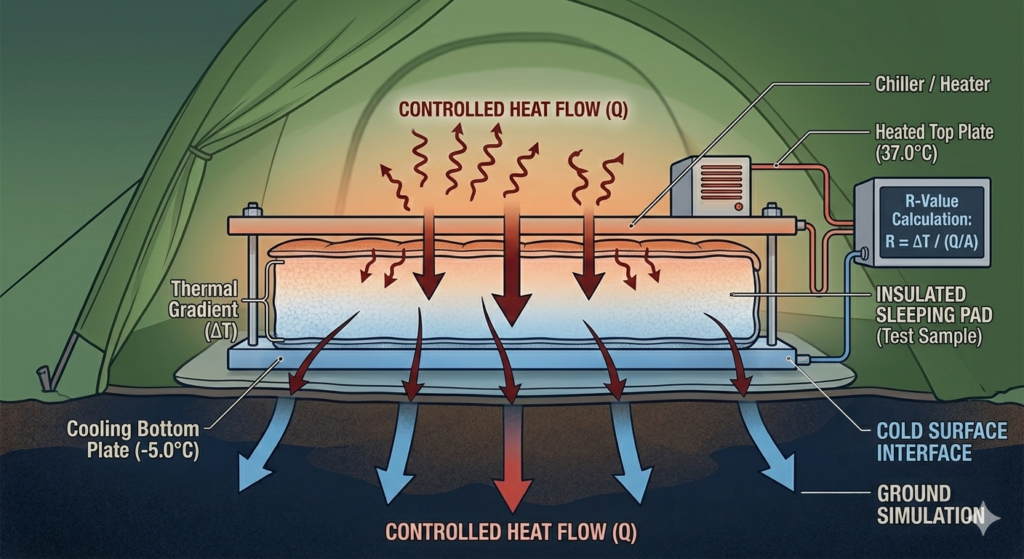
In simple terms, R-value measures a material’s ability to resist heat flow. The higher the number, the better the pad keeps your body heat from escaping into the dirt.
Before 2020, brands tested their gear however they wanted, leading to massive confusion. Today, we rely on the ASTM F3340-18 standard. This is a universal “apples-to-apples” test that ensures an R-value of 4.0 from one brand is exactly as warm as a 4.0 from another. When you’re miles into the wilderness, this consistency is a literal lifesaver.
Matching Your R-Value to the Real World
Choosing the right insulated sleeping pad depends entirely on the ground temperature. In our field tests across various terrains, we’ve found that most hikers underestimate how much insulation they actually need when the sun goes down.
The 2026 Temperature Correlation Table
| Adventure Type | Ground Temp | Suggested R-Value |
| Summer Strolls | Above 10°C | 1.0 – 2.0 |
| Spring/Fall Trekking | 0°C to 10°C | 2.1 – 3.9 |
| Winter Camping | -10°C to 0°C | 4.0 – 5.5 |
| Alpine & Snow | Below -10°C | 6.0+Adventure Type Ground Temp Suggested R-Value Summer Strolls Above 10°C 1.0 – 2.0 Spring/Fall Trekking 0°C to 10°C 2.1 – 3.9 Winter Camping -10°C to 0°C 4.0 – 5.5 Alpine & Snow Below -10°C 6.0+ |
Inflatable vs. Foam: The Battle for Insulation
Not all pads achieve their thermal resistance the same way. Depending on your style of hiking, your choice of materials matters as much as the number on the box.
Air Pads: The Weight-to-Warmth Kings
Modern air pads use reflective Mylar films to bounce radiant heat back to you. They offer the highest R-values for the lowest weight, making them the gold standard for 3-season backpacking.
Closed-Cell Foam (CCF): The Indestructible Backup
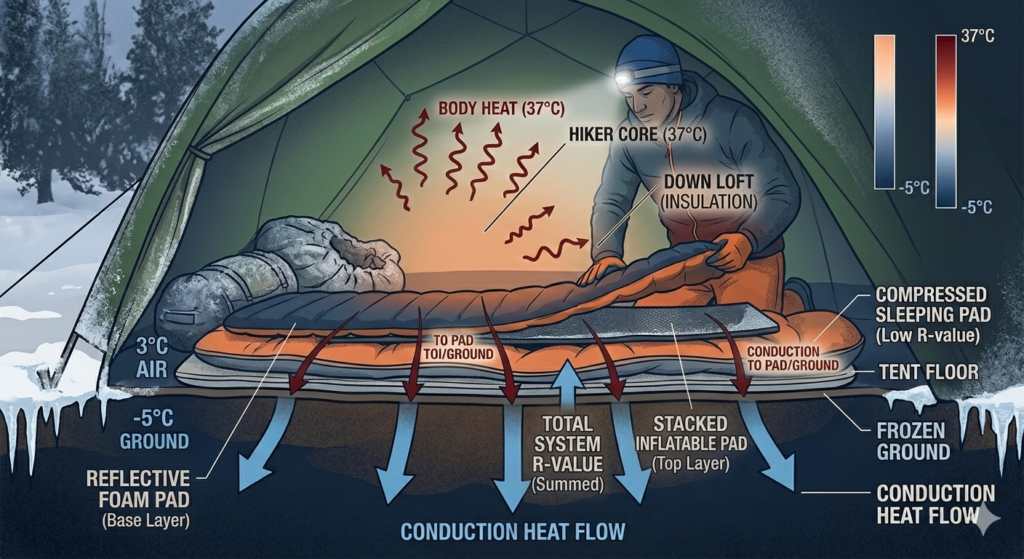
Foam pads usually tap out at an R-value of 2.0. However, they are “fail-proof.” Many winter explorers use a CCF pad under an air pad to boost the total R-value and protect against punctures.
The Stacking Hack: 1 + 1 = 3
One of the best-kept secrets in the outdoor community is that R-values are additive. If you have a summer pad with an R-value of 2.0 and you stack it on top of a foam pad with an R-value of 2.0, your total system now boasts an R-value of 4.0.
This is a game-changer for hikers on a budget. You don’t always need to buy a $250 winter pad; sometimes, you just need to layer what you already own. For a deep dive into the official testing protocols, you can explore the ASTM International standards which govern how this gear is rated.
FAQ: Common Sleeping Pad Myths
Q: Does a thicker pad mean it’s warmer? A: Not necessarily. A 4-inch thick “air mattress” with no internal insulation can have a lower R-value than a 1-inch technical pad filled with down or synthetic fibers.
Q: Can a pad be “too warm” for summer? A: Rarely. Unlike a sleeping bag, an R-value that is “too high” won’t make you sweat; it just stops the ground from cooling you down. You can use a winter pad in July, but you can’t use a summer pad in January.
Conclusion: Invest in Your Foundation
If you want to stop shivering and start sleeping, stop obsessing over your bag and fix your foundation. A high sleeping pad R-value is the difference between a miserable night and a peak-performance morning.